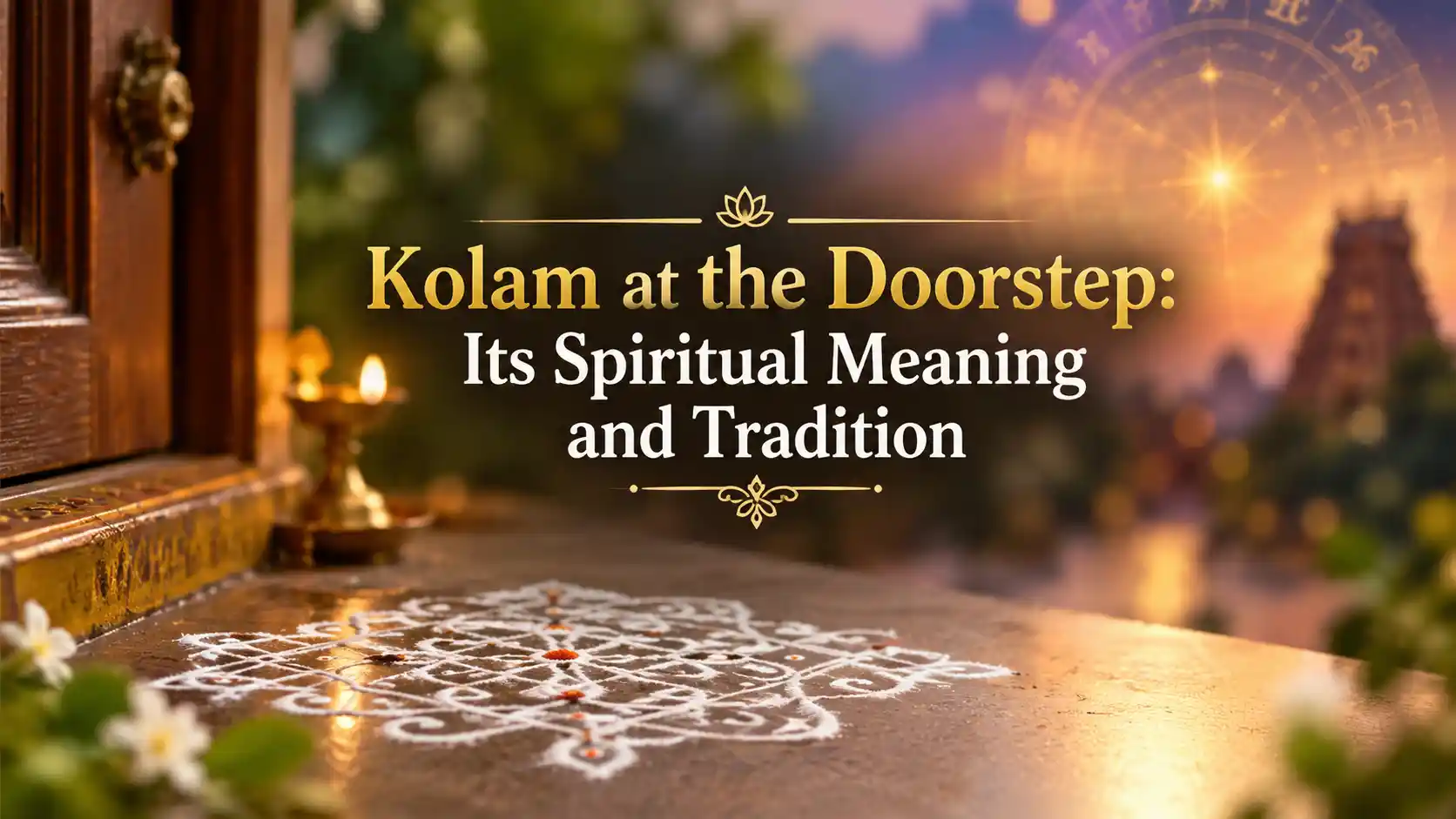
Are they simply drawn for decoration, or is there a deeper spiritual meaning behind them?
Early in the morning, the entrance is cleaned. A little water is sprinkled. Rice flour is taken in the hand. Dots are carefully placed, and slowly, those dots are connected with graceful curves.
Within a few minutes, a beautiful Kolam comes alive at the doorstep.
But Kolam is much more than decoration.
In Tamil tradition, the entrance is not simply a place to enter the house. It has also been viewed as a meaningful threshold between the outside world and the home.
Drawing Kolam at this entrance is traditionally associated with auspiciousness, welcome, order, harmony, and sharing.
Can a Home Feel Complete Without a Kolam?
According to traditional belief, a beautiful Kolam at the entrance represents Mangalam, meaning auspiciousness and positive beginnings.
In some Hindu traditions, drawing Kolam at the entrance is also associated with welcoming Goddess Lakshmi, who is traditionally connected with prosperity and abundance.
However, the deeper beauty may lie in the intention behind the practice.
A Kolam can silently express a simple wish:
May good thoughts enter this home.
May peace remain here.
May auspiciousness fill this space.
May happiness and abundance grow.
In this sense, drawing a Kolam can become a quiet Sankalpa, or an intentional prayer and positive resolve.
Every Dot Has a Story
How does a large Kolam begin?
With a single dot.
Then comes another, and another.
Soon, many dots come together. Lines are drawn around them, connecting, curving, and creating a beautiful pattern.
Isn’t that similar to life?
One dot alone may look insignificant. But when many dots come together, they can create something beautiful.
In the same way:
A good thought can become a good action.
A good action can become a good habit.
A good habit can slowly shape a meaningful life.
So, every time you place a dot, you can take it as a small reminder:
What good thought will I plant in my life today?
Why Was Rice Flour Traditionally Used?
Another beautiful aspect of Kolam is the traditional use of rice flour.
Rice flour was commonly used for making Kolams, and the flour could also become food for ants and other tiny creatures.
This practice can be understood as an expression of sharing and living in harmony with the world around us.
The message is simple:
This world does not belong to us alone. There is a place here for every living being.
Think about it.
One of the first activities of the day was not simply decorating the entrance. It could also involve sharing something with another living being.
This makes Kolam more than an art form. It can also serve as a reminder of compassion, coexistence, and interconnectedness.
Is Drawing Kolam a Form of Meditation?
Kolam can also be experienced as a quiet and mindful daily practice.
The dots need to be placed carefully. The lines need to flow smoothly. The curves require patience. The design requires attention and balance.
While creating the Kolam, the mind naturally focuses on the pattern.
For a few peaceful moments in the morning, the outside world can become quieter, allowing the mind to slow down and become more attentive.
As a beautiful pattern appears outside, a little stillness may also appear within.
This is one of the subtle beauties of Kolam.
Why Is Kolam Traditionally Drawn in the Morning?
For generations, cleaning the entrance and drawing Kolam in the early morning has been part of traditional Tamil household practices.
Imagine a quiet morning.
The day has not yet become busy.
The entrance has been cleaned. Rice flour is held gently between the fingers.
One dot appears.
Then another.
Slowly, a pattern takes shape.
For many households, this can become a peaceful beginning to the day.
Kolam therefore does not simply beautify the entrance. It can also encourage a mindset of beginning the day with attention, order, and positive thoughts.
What Happens When the Kolam Gets Destroyed?
Here lies one of the most beautiful lessons associated with Kolam.
You may spend time creating a beautiful design in the morning, but within a few hours, it may change.
Someone may walk over it.
The wind may disturb it.
Rain may wash it away.
Tiny creatures may feed on the flour.
By evening, the Kolam may no longer look the same.
And the next morning, a new Kolam appears again.
Isn’t that a beautiful reflection on life?
Nothing remains exactly the same forever.
What disappears today can be created again tomorrow.
The Kolam may disappear, but the intention behind creating it does not have to disappear.
From a Dot to a Prayer
A traditional Kolam can be understood through several simple ideas.
Cleaning the entrance
A reminder of outer cleanliness and preparation.
Placing the dots
A reminder to bring order and focus to our thoughts.
Connecting the lines
A reflection of how different parts of life can come together.
Creating the Kolam
An expression of beauty, patience, and auspiciousness.
Watching it fade away
A reminder that everything changes.
Drawing again the next morning
An opportunity to embrace a fresh beginning.
This is the deeper beauty that many people find in the practice of Kolam.
The Next Time You Draw a Kolam
Take a little rice flour in your hand.
Place the first dot and think:
“May peace remain in my home today.”
Place another dot:
“May good thoughts grow within me.”
Draw a line:
“May my life move towards good paths.”
And when the Kolam is complete:
“May this day begin with Mangalam.”
This does not have to be understood as a promise of supernatural results.
Instead, it can be viewed as a way of creating a meaningful spiritual mindset and beginning the day with intention, gratitude, and positivity.
The Spiritual Beauty of Kolam
Kolam at the doorstep can represent many things at once.
It is a tradition.
It is an art form.
It can express sharing and coexistence.
It can encourage patience and attention.
It is traditionally associated with auspiciousness.
And for many people, it can become a silent prayer.
The Kolam drawn at the doorstep may disappear beneath footsteps, rain, wind, or time. But the good thoughts planted in our hearts while drawing it can remain with us.
That is the true spiritual beauty of Kolam.
A Kolam at the doorstep can become a reminder of a good thought in the heart and a Mangalam beginning at home.
Final Thoughts
So, the next time you see a Kolam at a doorstep, don’t see it merely as a beautiful design.
Look a little deeper.
Behind those dots and graceful lines is a tradition that brings together art, discipline, sharing, mindfulness, auspiciousness, and the idea of beginning each day with positive intention.
A simple Kolam may disappear by evening.
But the values associated with it can continue far beyond the doorstep.