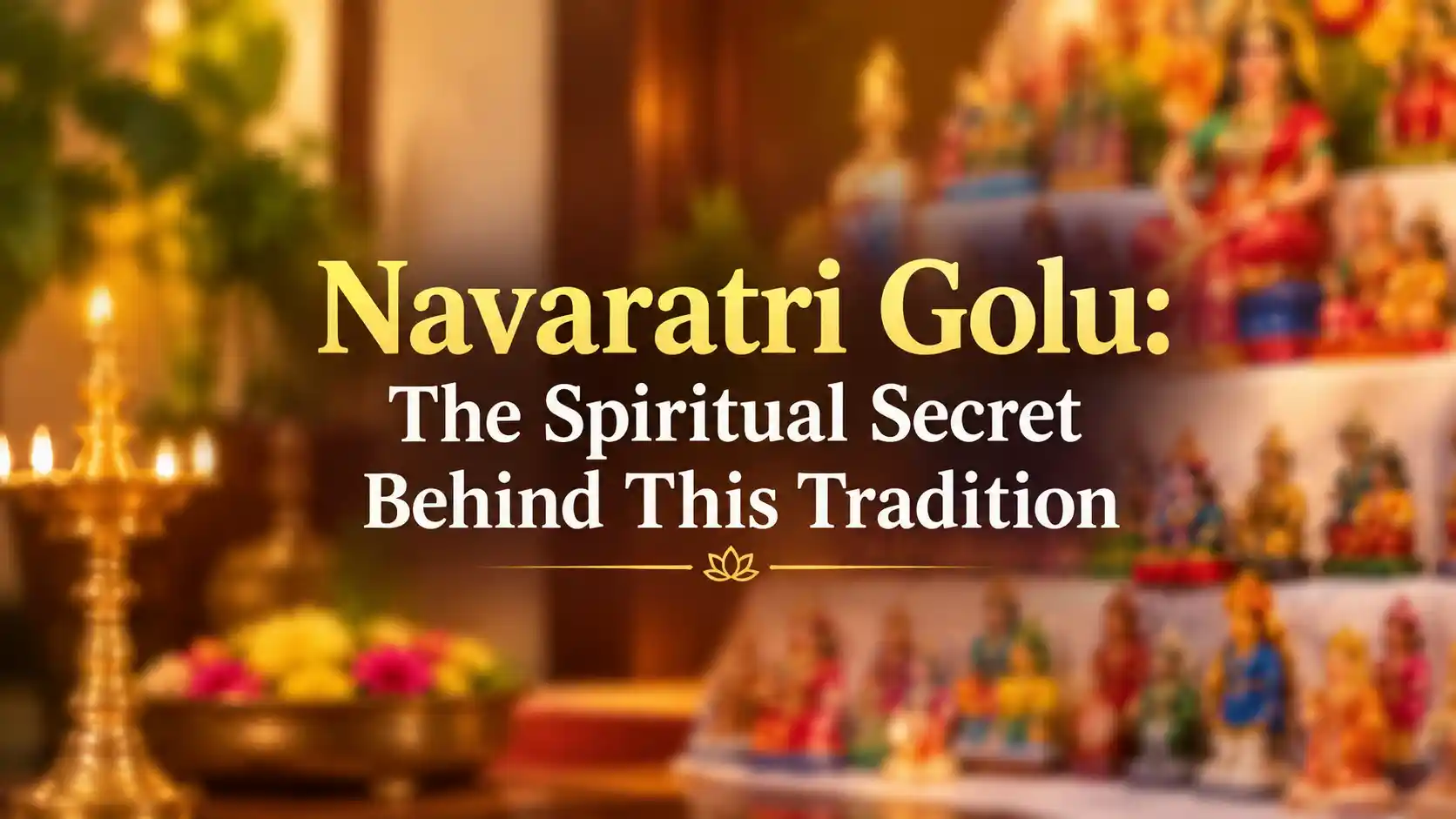
When Navaratri arrives, something seems to change inside many homes.
The fragrance of flowers fills the air. The glow of lamps brightens the prayer space. Devotional songs create a peaceful atmosphere. And then comes one of the most fascinating parts of the celebration: the beautiful Golu steps filled with colourful dolls.
But have you ever paused and wondered why these dolls are arranged on steps?
Is Golu simply a beautiful Navaratri decoration?
Or is there a deeper spiritual message hidden behind every step?
Let us explore the beautiful meaning behind this timeless tradition.
Golu Is More Than Just a Display
In many South Indian families, Golu is a cherished Navaratri tradition where dolls and figurines are arranged on specially decorated steps.
At first glance, it may look like a colourful display. But spiritually, Golu can be understood as a representation of life, devotion and the journey towards greater wisdom.
Every doll has a place.
Every step has a purpose.
Together, they create a reminder that life itself is a journey, one step at a time.
Why Are the Dolls Arranged on Steps?
This is where the beauty of Golu becomes even more fascinating.
In some traditional interpretations, the steps can be understood as a symbolic journey from the ordinary towards the divine.
The lower levels may contain representations of animals, people, nature and everyday life. As the steps rise, divine figures are often placed higher.
This creates a beautiful spiritual thought.
Life begins with the world around us, but the journey towards greater awareness and wisdom can happen gradually.
One step at a time.
One experience at a time.
One lesson at a time.
Just like the Golu steps, our lives also have different stages.
The Divine Presence of Shakti
Navaratri is deeply associated with the worship of Goddess Shakti, the divine feminine power.
The nine nights are traditionally dedicated to different expressions of divine energy, although regional traditions vary in their forms and practices.
Golu becomes a beautiful way of bringing that devotional atmosphere into the home.
The dolls may be silent, but the prayer space feels alive with devotion.
The lamp shines. Flowers decorate the space. Sacred names are chanted. Family members gather together in a spirit of prayer and celebration.
That is one of the enduring beauties of Golu: it brings devotion into everyday family life.
Every Doll Can Tell a Story
Look closely at a Golu display.
You may find divine figures, saints, village scenes, animals, birds, musicians, farmers, families and many other forms of life.
Why such variety?
Because life is not made up of just one thing.
Nature, people, animals, work, relationships, knowledge and spirituality are all connected.
A Golu display can therefore become a colourful reminder of the diversity of creation.
Every little figure has its own place, just as every person has their own role and journey in life.
The Spiritual Journey Hidden in the Steps
Imagine climbing a staircase.
You do not reach the top in one giant leap.
You take one step, then another, and then another.
The same idea can beautifully describe spiritual growth.
We may begin with confusion.
Then come experiences.
Experiences bring understanding.
Understanding can lead to wisdom.
And wisdom may gradually lead us towards inner peace.
The Golu steps can therefore remind us that spiritual growth is not necessarily about reaching somewhere instantly. It can be about moving forward one meaningful step at a time.
The Story of Goodness Over Evil
Navaratri is also associated with the victory of divine power over forces of evil in Hindu traditions.
The story of Goddess Durga’s victory over Mahishasura is one of the best-known examples.
Its deeper spiritual message can be understood as the triumph of courage over fear, wisdom over ignorance and righteousness over negativity.
This makes Navaratri more than a celebration. It can also become an opportunity for inner reflection.
We can ask ourselves:
What fear do I need to overcome?
What negative thought should I let go of?
Where do I need more courage?
The divine stories remind devotees that meaningful victories can also begin with changes within ourselves.
Golu and the Beauty of Sharing
There is another beautiful part of the tradition.
During Navaratri, families often invite relatives, friends and neighbours to see the Golu.
Women and children may gather together for devotional songs and prayers. Traditional offerings are shared, and blessings are exchanged.
In many families, gifts such as sundal and tambulam are also shared according to custom.
So Golu is not only about arranging dolls.
It is also about opening the doors of the home and sharing happiness with others.
A home becomes brighter when its happiness is shared.
A prayer can become more meaningful when it brings people together.
A Tradition That Connects Generations
Perhaps one of the most beautiful aspects of Golu is the way the tradition passes from one generation to another.
Children learn how to arrange the dolls.
Grandparents share stories.
Parents continue family customs.
Songs and prayers are taught.
Memories are created.
Slowly, a simple tradition becomes a precious part of family life.
Golu does not simply preserve dolls. It can also preserve memories, values, devotion and family traditions.
The Lamp, the Flowers and the Silence
Imagine an evening during Navaratri.
A small lamp glows beside the Golu.
Fresh flowers decorate the sacred space.
The fragrance of incense gently fills the room.
Devotional music can be heard in the background.
For a few peaceful moments, the busy world seems to become quieter.
That peaceful atmosphere is itself part of the beauty of the tradition.
Sometimes spirituality does not need complicated words.
A glowing lamp can remind us of hope.
A flower can remind us of purity.
A prayer can remind us to be grateful.
And a Golu can remind us to keep moving forward, one step at a time.
So, What Is the Spiritual Secret Behind Golu?
Perhaps one of the most meaningful aspects of Golu is the way it turns an ordinary home into a space filled with devotion, creativity, togetherness and positive memories.
The dolls may be made of clay, wood or other materials, but the meaning associated with them comes from tradition and personal devotion.
The steps may be temporary, but the values they represent can remain with us long after Navaratri ends.
That is what makes this tradition so beautiful.
Golu teaches us to celebrate life.
It reminds us to keep the light of hope alive.
It encourages us to move towards wisdom.
It brings families and communities together.
Above all, it reminds us that every journey can become meaningful when it is approached with faith and devotion.
A Beautiful Message to Carry Forward
The next time you stand before a Navaratri Golu, do not look at it merely as a collection of dolls.
Look at the steps and think about your own journey.
Maybe you are standing on a difficult step today.
Maybe tomorrow will take you one step higher.
You do not have to reach the top all at once.
Keep moving.
Keep learning.
Keep your inner light shining.
Because, just like the Golu steps, every step in life can carry its own meaning.
Sometimes, even a small step taken with faith can lead us towards something beautiful.
May the divine grace of Shakti fill every home with peace, hope, happiness and positive energy.
Happy Navaratri.