Have you ever wondered why two people born on the same day can have completely different personalities, careers, or life experiences?
Many people assume that a horoscope is based only on their zodiac sign. In reality, Vedic astrology (Jyotish) goes far beyond the Sun sign or Moon sign. A traditional horoscope is created by calculating the exact positions of the planets at the precise moment and location of birth.
This process combines astronomy, mathematics, and centuries of astrological knowledge to prepare a personalized birth chart. Every planet, house, zodiac sign, and planetary relationship contributes to understanding different aspects of life.
In this guide, you’ll learn how a horoscope is calculated using the traditional Vedic astrology method, why birth time matters, and how astrologers interpret a birth chart.
What Is a Horoscope?
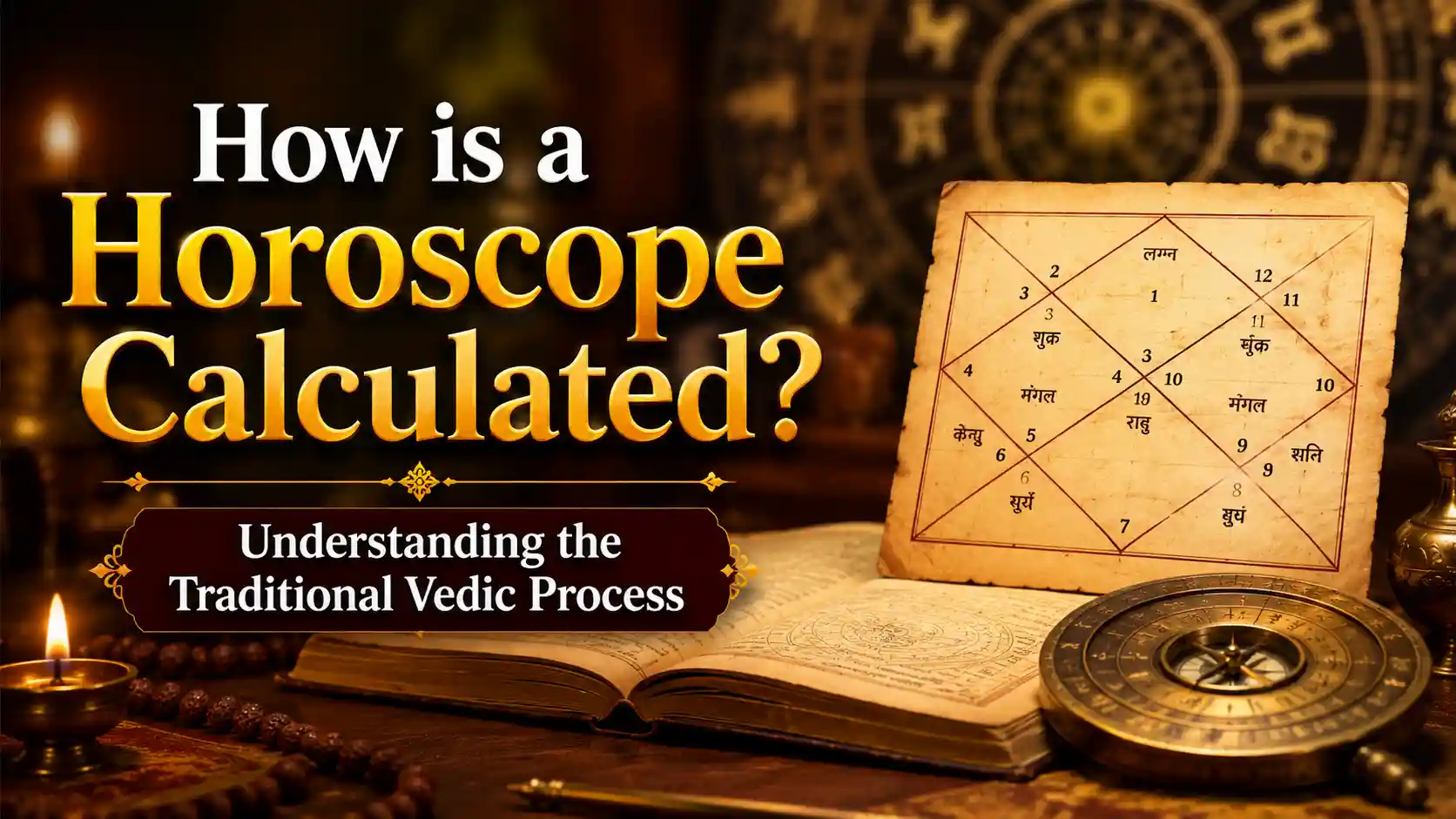
A horoscope, also called a birth chart or Janma Kundli, is a map of the sky at the exact moment you were born.
It records the positions of:
- The Ascendant (Lagna)
- Nine planets (Navagrahas)
- Twelve zodiac signs
- Twelve astrological houses
- Twenty-seven Nakshatras (Lunar Mansions)
Astrologers study these positions to understand various aspects of life, including personality, education, career, marriage, health, finances, and spiritual growth.
A horoscope is not intended to predict every event with certainty. Instead, it serves as a guide that helps identify strengths, challenges, and favorable opportunities.
Why Are Birth Details So Important?
A horoscope can only be calculated accurately when three essential details are available.
1. Date of Birth
The birth date helps determine the planetary positions for that specific day.
2. Exact Time of Birth
Even a difference of a few minutes can change the Ascendant (Lagna), which significantly affects horoscope interpretation.
3. Place of Birth
The Earth’s rotation causes the Ascendant and planetary positions to vary depending on geographical location.
Without accurate birth details, the horoscope may not reflect the correct planetary alignment.
Step-by-Step: How a Horoscope Is Calculated
Step 1: Calculating the Ascendant (Lagna)
The first and most important step is determining the Ascendant, also known as the Lagna.
The Ascendant is the zodiac sign rising on the eastern horizon at the exact time of birth.
It represents:
- Physical appearance
- Personality
- Life direction
- Overall approach to life
In Vedic astrology, the Lagna often carries greater importance than the zodiac (Moon sign).
Step 2: Determining Planetary Positions
Next, the astrologer calculates the positions of the nine planets.
These include:
- Sun
- Moon
- Mars
- Mercury
- Jupiter
- Venus
- Saturn
- Rahu
- Ketu
Each planet occupies a particular zodiac sign and house, creating unique combinations within the birth chart.
Step 3: Dividing the Horoscope into Twelve Houses
The horoscope is divided into 12 houses, each representing a different area of life.
| House | Represents |
|---|---|
| 1 | Personality, body, self |
| 2 | Family, wealth, speech |
| 3 | Courage, communication |
| 4 | Mother, home, happiness |
| 5 | Education, children, creativity |
| 6 | Health, debts, competition |
| 7 | Marriage, partnerships |
| 8 | Longevity, transformation |
| 9 | Fortune, spirituality |
| 10 | Career, profession |
| 11 | Income, achievements |
| 12 | Expenses, foreign travel, liberation |
The strength of each house depends on its ruling planet and planetary influences.
Step 4: Identifying the Nakshatra
The Moon’s position determines the person’s Nakshatra (Birth Star).
Vedic astrology recognizes 27 Nakshatras, each with unique characteristics.
The Nakshatra plays a major role in:
- Personality analysis
- Dasha calculations
- Marriage compatibility
- Spiritual tendencies
Step 5: Calculating the Dasha System
One of the unique features of Vedic astrology is the Vimshottari Dasha System.
This planetary timing system helps astrologers understand when specific life events are more likely to occur.
Dashas are commonly used to analyze:
- Career growth
- Marriage timing
- Financial opportunities
- Health challenges
- Major life changes
Step 6: Evaluating Planetary Strength
Every planet is examined to determine its overall strength.
Astrologers study whether a planet is:
- Exalted
- Debilitated
- In its own sign
- In a friendly sign
- In an enemy sign
A strong planet generally delivers more favorable results, while a weak planet may indicate challenges that require greater effort or patience.
Step 7: Examining Planetary Aspects and Yogas
Planets influence one another through their aspects.
Astrologers also identify important planetary combinations known as Yogas.
Some well-known Yogas include:
- Raja Yoga
- Gaja Kesari Yoga
- Dhana Yoga
- Neecha Bhanga Raja Yoga
- Dharma Karma Adhipati Yoga
These combinations can strengthen specific areas of life depending on the entire chart.
A Simple Example
Imagine two children born on the same date.
- Child A is born at 6:10 AM in Chennai.
- Child B is born at 6:28 AM in Coimbatore.
Although they may share the same Moon sign, their Ascendants may differ because of the change in birth time and location.
As a result, their career paths, relationships, health patterns, and life experiences may unfold differently.
This illustrates why accurate birth details are essential for preparing a reliable horoscope.
What Does an Experienced Astrologer Analyze?
Professional Vedic astrologers do not rely on a single planet or zodiac sign.
Instead, they evaluate the complete birth chart by studying:
- Lagna
- Lagna Lord
- Moon Sign
- Planetary Strength
- House Lords
- Yogas
- Dasha Periods
- Planetary Transits (Gochar)
- Navamsa (D9 Chart)
This comprehensive approach provides a more balanced and meaningful interpretation.
Common Misconceptions About Horoscope Calculation
Many people misunderstand how horoscopes work.
Some common misconceptions include:
- A zodiac sign alone defines your entire life.
- Free online horoscope reports are always complete.
- Birth time is not important.
- One weak planet means lifelong bad luck.
- Every person with the same zodiac sign has the same destiny.
Traditional Vedic astrology considers the complete birth chart rather than a single factor.
Benefits of Understanding Horoscope Calculation
Learning how horoscopes are calculated helps you:
- Understand the basics of Vedic astrology.
- Read your birth chart more confidently.
- Appreciate the importance of accurate birth details.
- Avoid misleading or incomplete horoscope interpretations.
- Make informed decisions when consulting an astrologer.
Summary Table
| Element | Purpose |
|---|---|
| Date of Birth | Determines planetary positions |
| Time of Birth | Calculates the Ascendant |
| Place of Birth | Adjusts planetary coordinates |
| Nine Planets | Influence different life areas |
| Twelve Houses | Represent life experiences |
| Nakshatra | Determines birth star and Dasha |
| Dasha System | Indicates planetary periods |
| Navamsa Chart | Provides deeper chart analysis |
Conclusion
A horoscope is far more than a simple zodiac prediction. Traditional Vedic astrology calculates a birth chart using precise birth details, planetary positions, the Ascendant, houses, Nakshatras, Dashas, and several advanced astrological principles.
Understanding how a horoscope is calculated allows you to appreciate the depth of Vedic astrology and recognize why accurate birth information is essential. Rather than viewing a horoscope as a fixed prediction of destiny, it is better understood as a guide that highlights opportunities, challenges, and areas of personal growth.
Frequently Asked Questions
1. What information is required to calculate a horoscope?
Your exact date of birth, time of birth, and place of birth are essential.
2. Why is birth time so important?
Birth time determines the Ascendant (Lagna), which influences the structure of the entire horoscope.
3. Can two people with the same zodiac sign have different horoscopes?
Yes. Differences in birth time and location can produce different Ascendants and house placements.
4. Is a computer-generated horoscope accurate?
Software accurately calculates planetary positions, but meaningful interpretation requires the knowledge and experience of a qualified Vedic astrologer.
5. Does a horoscope determine my future?
No. A horoscope is traditionally viewed as a guide for understanding life patterns, strengths, challenges, and potential opportunities rather than a fixed prediction.