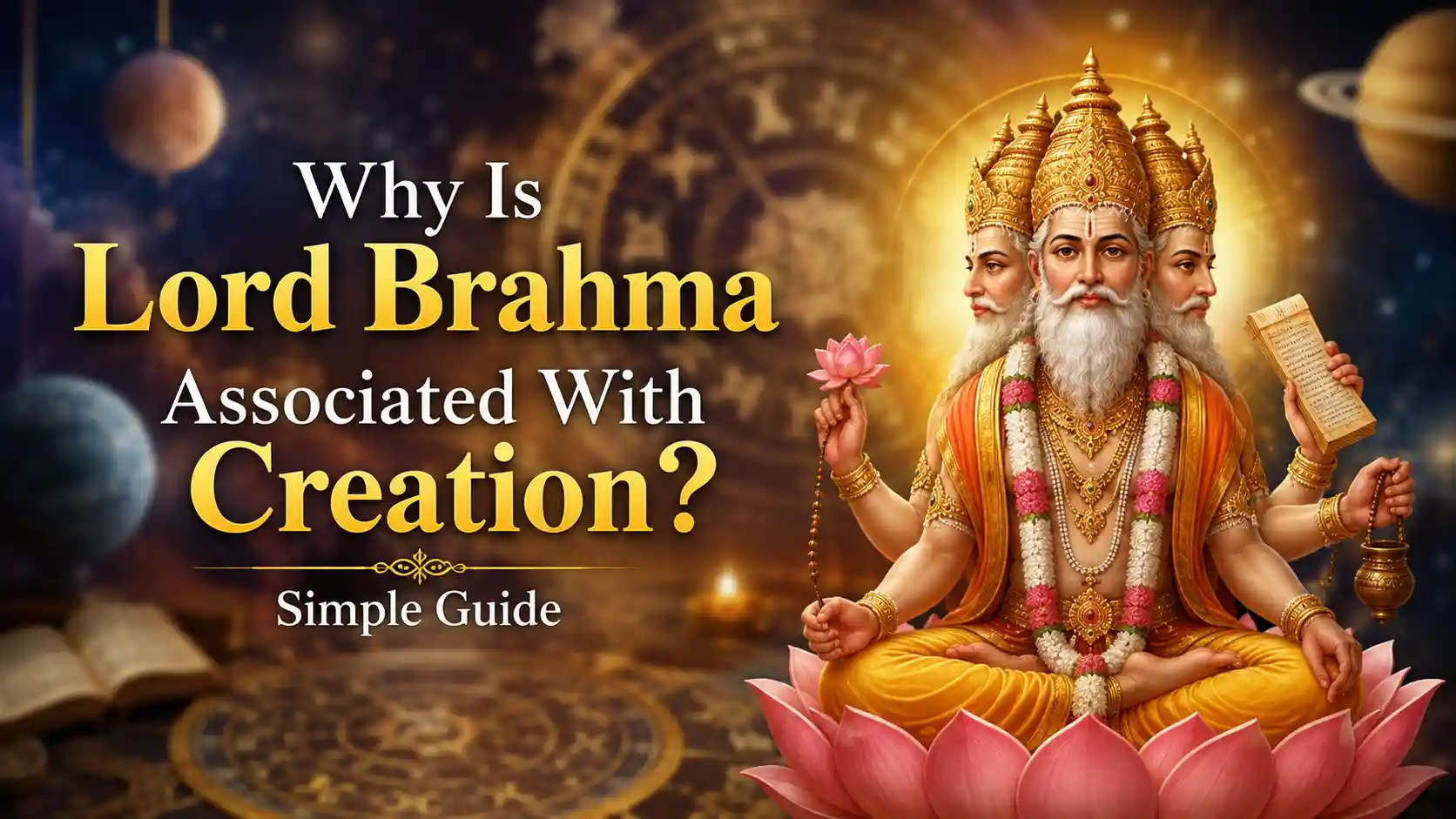
When we think about creation in Hindu tradition, one name naturally comes to mind: Lord Brahma. Often described as the creator among the Hindu Trimurti, Brahma has a unique place in Hindu philosophy, mythology, and spiritual thought.
But why exactly is Lord Brahma associated with creation? And what does “creation” really mean in the Hindu understanding?
The answer goes beyond the simple idea of a god who created the world. Ancient Hindu traditions present creation as part of a much larger cosmic cycle involving creation, preservation, and transformation.
Let’s explore the story in a simple and meaningful way.
Who Is Lord Brahma?
Lord Brahma is traditionally regarded as the creator deity in the Hindu Trimurti, the three principal divine functions represented by Brahma, Vishnu, and Shiva.
- Brahma is associated with creation.
- Vishnu is associated with preservation and protection.
- Shiva is associated with dissolution and transformation.
This does not necessarily mean that these three deities function like three separate gods performing independent jobs. In many Hindu philosophical traditions, they represent different aspects of the cosmic process.
Brahma, therefore, represents the principle through which life, beings, and the universe come into manifestation.
Why Is Brahma Called the Creator?
The association between Brahma and creation comes from Hindu scriptures and traditional stories that describe the beginning and continuation of the universe.
One well-known account connects Brahma with the cosmic lotus. In this tradition, a lotus emerges from Lord Vishnu, and Brahma appears upon it. He then begins the work of bringing different forms of life and existence into manifestation.
Different Hindu texts tell the creation story in different ways, so there is no single version that explains creation for every Hindu tradition.
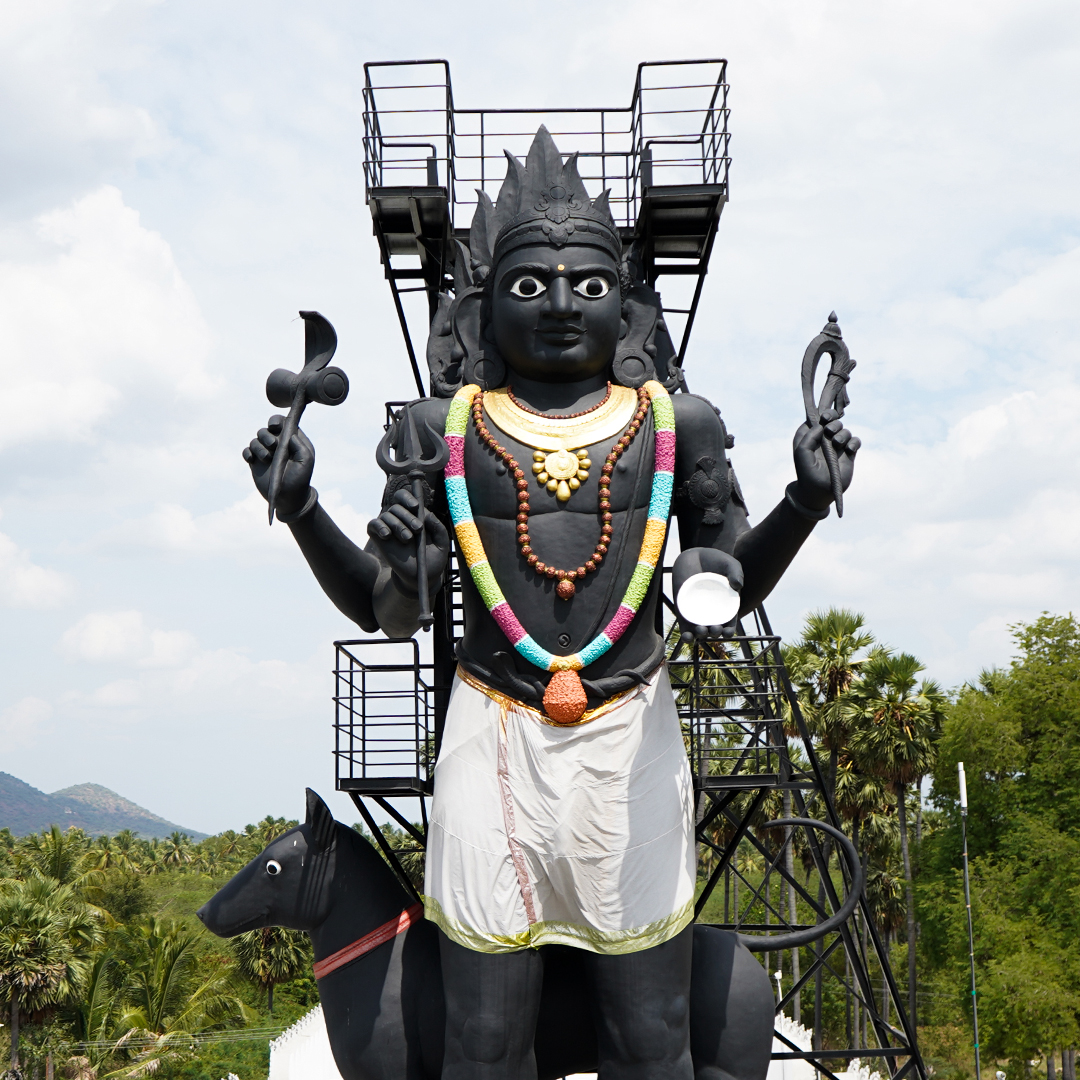
Hindu traditions also include many other important divine forms, such as Bhairava, who is traditionally associated with Shiva and is worshipped in different forms across India.
That variety is important.
Hindu mythology often presents cosmic events through symbolic stories rather than a single fixed narrative. The stories encourage us to think about where life comes from, how order emerges, and how the universe continues through cycles.
The Deeper Meaning of Creation
The word “creation” can sometimes make Brahma’s role sound very straightforward: create the universe and everything in it.
But Hindu philosophy often approaches creation in a more layered way.
Creation can be understood as manifestation—the process through which existence takes different forms.
Think about a seed. A seed contains the potential for a tree, but the tree appears only when the right conditions allow that potential to unfold.
In a similar symbolic sense, Brahma represents the creative principle through which the possibilities of existence become manifest.
This is one reason Brahma’s role is fascinating. He is not simply a character in an ancient story. He can also be understood as a representation of the cosmic process of bringing order, life, knowledge, and form into existence.
Brahma and the Cosmic Cycle
One of the most interesting aspects of Hindu cosmology is that the universe is often viewed as cyclical.
Creation is not necessarily seen as a one-time event followed by an endless continuation.
Instead, Hindu traditions describe enormous cycles of:
Creation → Preservation → Dissolution → Renewal
Brahma’s role belongs primarily to the first stage of this cycle.
Vishnu represents preservation, while Shiva represents dissolution and transformation. Once dissolution takes place, another cycle of manifestation can begin.
This cyclical view is quite different from the idea of a universe with only one beginning and one final ending.
It also gives Brahma’s role a broader meaning: creation is one part of an ongoing cosmic rhythm.
What Does Brahma Symbolize?
Lord Brahma is traditionally depicted with four faces, which are often interpreted symbolically in different ways.
The four faces can be associated with the four Vedas and the four directions. Brahma is also traditionally shown with objects such as the Vedas, a water pot, a rosary, and a lotus.
These symbols connect him with knowledge, wisdom, creation, and cosmic order.
The lotus itself is especially meaningful in Hindu symbolism. It can represent purity, spiritual growth, and the emergence of something beautiful from its surroundings.
So when Brahma is shown seated on a lotus, the image can be understood as more than a visual detail. It connects the idea of creation with the unfolding of existence.
Brahma and the Four Vedas
Brahma’s connection with knowledge is another important part of his identity.
The four Vedas hold a central position in Hindu religious tradition, and Brahma is traditionally associated with them. His four faces are commonly connected with the four Vedas.
This creates an interesting link between creation and knowledge.
From a philosophical perspective, creation is not merely about producing physical objects. Bringing the universe into an ordered existence also involves knowledge, structure, and principles that allow life and society to function.
In this sense, Brahma represents creative intelligence as much as physical creation.
Why Is Brahma Worship Less Common Today?
A question often comes up when people learn about the Trimurti:
If Brahma is the creator, why are there fewer temples dedicated to him compared with Vishnu or Shiva?
There is no single universally accepted answer.
Hindu worship developed through many different traditions, communities, regional practices, and devotional movements. Over time, Vishnu, Shiva, Devi, and other forms of the divine became especially prominent in major devotional traditions.
There are still temples dedicated to Brahma. One of the best-known examples is the Brahma Temple at Pushkar in Rajasthan, which is an important pilgrimage site.
The comparatively smaller number of Brahma temples does not mean that his role in Hindu cosmology is unimportant. His significance remains strong in religious stories, iconography, philosophy, and traditional accounts of creation.
Brahma, Vishnu, and Shiva: A Simple Way to Understand the Trimurti
A simple way to remember the traditional roles of the Trimurti is:
| Deity | Traditional association | Broader idea |
|---|---|---|
| Brahma | Creation | Manifestation |
| Vishnu | Preservation | Protection and order |
| Shiva | Dissolution | Transformation and renewal |
These descriptions are useful for understanding the basic concept, but Hindu theology is much more diverse than this three-line summary suggests.
Different schools of Hindu thought interpret the relationships among these deities in different ways.
That is why it is better to see the Trimurti as a helpful framework rather than assuming that every Hindu tradition understands the three deities in exactly the same way.
Why Brahma’s Story Still Matters
The story of Brahma offers an interesting way to think about one of life’s biggest questions: How does existence come into being?
Whether someone approaches the story religiously, philosophically, or culturally, Brahma represents an idea that remains easy to relate to—the power of creation.
Everywhere around us, creation happens in different forms. A child is born, a plant grows, an artist creates a painting, a writer develops a story, and a new idea takes shape.
At a symbolic level, Brahma reminds us of this movement from possibility to manifestation.
That may be one reason his image has remained part of Hindu tradition for thousands of years.
Final Thoughts
Lord Brahma is associated with creation because Hindu traditions traditionally identify him as the divine force responsible for bringing the universe and living beings into manifestation.
His role becomes even clearer when viewed alongside Vishnu and Shiva. Together, the Trimurti provides a traditional framework for understanding creation, preservation, and dissolution as interconnected parts of cosmic existence.
At a deeper level, Brahma can also be understood as a symbol of creative intelligence, knowledge, order, and the unfolding of potential.
So, when someone asks, “Why is Lord Brahma associated with creation?”, the answer is not simply that Brahma is the creator god.
It is that Brahma represents one of the fundamental movements of existence itself: the emergence of life and form from potential into manifestation.