A Plant That Became Part of the Indian Home
In many Indian households, the Tulsi plant occupies a place that is very different from an ordinary decorative plant.
It may stand in a courtyard, grow in a raised structure, or live in a simple pot on a balcony. Yet its presence often carries memories that extend far beyond gardening.
For some families, Tulsi is connected with daily prayer. For others, it reminds them of grandparents, traditional homes and childhood routines. In a modern apartment, a small Tulsi pot can become a connection to an older way of life in which plants, family rituals and daily routines were closely connected.
Tulsi is commonly known in English as Holy Basil and is generally associated with the species Ocimum tenuiflorum, also known in older botanical references as Ocimum sanctum.
Its significance can be understood from several perspectives: religious, cultural, environmental and botanical.
These perspectives overlap, but they should not be confused. A plant can be spiritually meaningful without every traditional medical claim about it being scientifically proven.
Understanding that distinction allows us to appreciate Tulsi more honestly.
Why Is Tulsi Considered Sacred?
Tulsi holds a special position in many Hindu traditions, particularly those associated with Vishnu and Krishna.
Its leaves are commonly used in devotional practices, and the plant itself is often treated with a degree of reverence not usually given to ordinary household vegetation.
The sacred status of Tulsi is connected with religious stories and beliefs that have been passed down through generations.
However, there is also a broader cultural meaning behind the practice.
By giving a plant a central role in household life, traditional communities ensured that nature remained physically present in the daily environment.
The relationship was not limited to visiting a temple or participating in an annual festival. The plant had to be cared for regularly.
It needed water.
It needed sunlight.
It changed with the seasons.
This created a daily relationship between people and a living part of nature.
The Meaning of the Traditional Tulsi Maadam
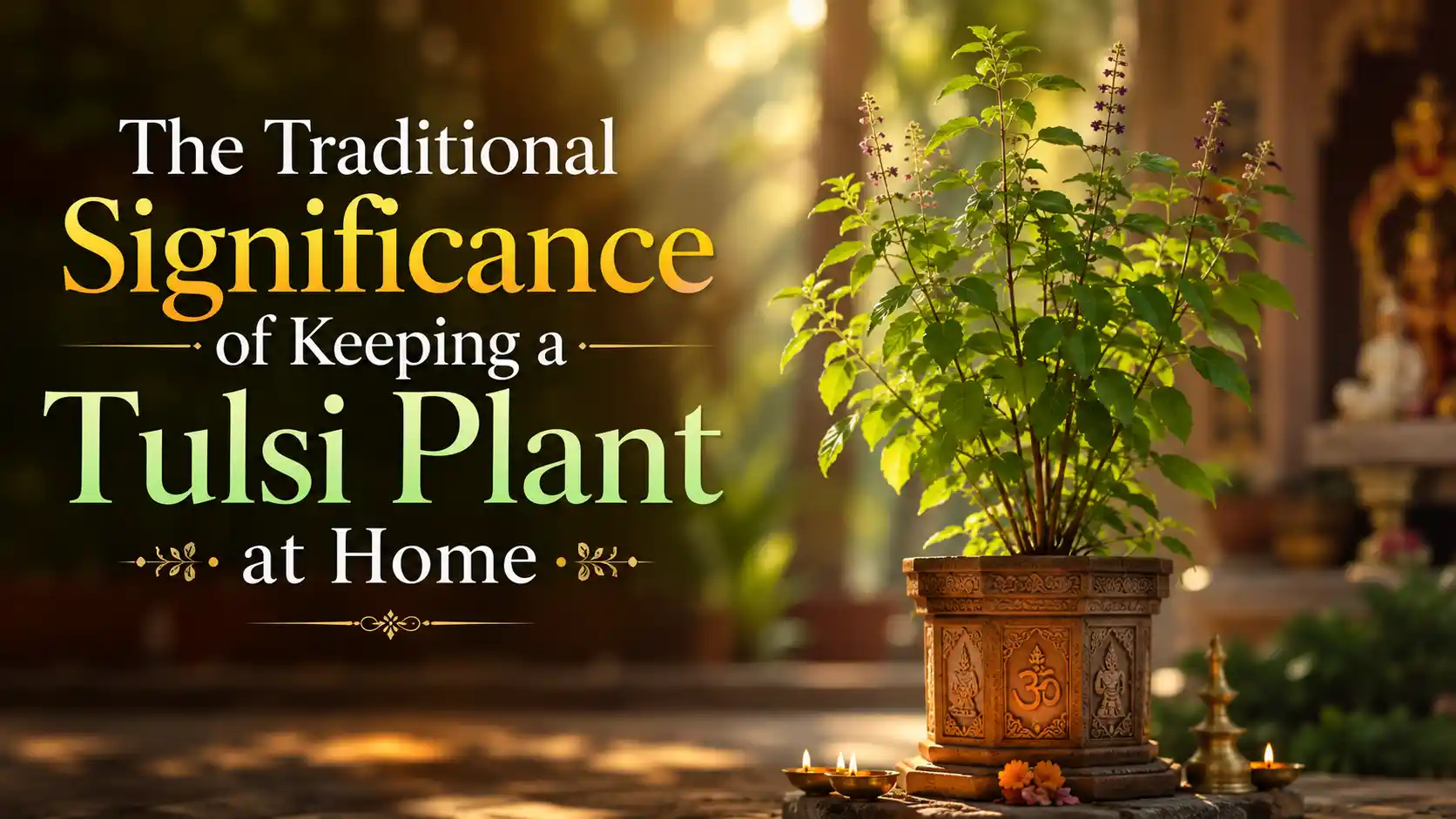
In many traditional South Indian homes, Tulsi was grown in a specially constructed raised platform, often called a Tulsi Maadam.
This structure was not simply a plant holder.
It could become a focal point of the household.
Family members might water the plant, light a lamp nearby or spend a few quiet moments around it in the morning or evening.
These practices created rhythm.
Modern life often operates through notifications, schedules and constant movement. Traditional household routines were also structured, but they were frequently connected with natural events such as sunrise, sunset and seasonal changes.
A Tulsi plant could become part of that rhythm.
The value of such a routine should not be underestimated. Repeated small actions can shape how people experience time. Watering a plant each morning may take only a few minutes, but it can create a moment of attention before the rest of the day begins.
Tulsi and the Idea of a Living Home
A house becomes a home through more than furniture and walls.
Traditional Indian homes often included spaces for trees, plants, animals, water and open air. The courtyard was not simply empty space. It connected the built environment with the natural world.
Tulsi became one of the symbols of this relationship.
Keeping a plant at home represented care, continuity and connection.
A living plant also changes the way people interact with a space. Unlike an object, it cannot simply be placed somewhere and forgotten. It responds to light, water, temperature and attention.
This makes Tulsi a useful reminder that homes can contain living relationships with nature, even in highly urban environments.
Today, not everyone has a courtyard. Many people live in apartments with limited outdoor space. But a small pot on a balcony or near a sunny window can still preserve the basic idea.
Tradition does not always have to remain physically identical to the past in order to remain meaningful.
Tulsi in Traditional Health Practices
Tulsi has a long history of use in Ayurveda and other traditional practices in South Asia.
Its leaves are commonly included in herbal preparations, teas and household remedies. Because the plant contains naturally occurring chemical compounds, it has also attracted scientific interest.
Researchers have studied different components of Tulsi and their possible biological activities.
However, scientific interest should not be confused with proof that Tulsi can cure every disease.
Online health claims frequently exaggerate the abilities of traditional plants. A person may encounter statements claiming that Tulsi can completely cure diabetes, eliminate every infection or replace prescribed medication.
Such claims should be treated cautiously.
A plant extract may show biological activity in a laboratory, but that does not automatically mean that chewing a few leaves will produce the same effect in a human body.
Dosage, preparation, concentration, individual health conditions and possible interactions all matter.
Tulsi can be appreciated as a traditional plant without turning it into a miracle cure.
Nature Is Not a Substitute for Medical Care
One of the most important lessons when discussing traditional herbs is that “natural” and “safe” are not identical concepts.
Plants can contain active substances. Those substances can interact with the body and, in some cases, with medications.
For a generally healthy person, using Tulsi as a culinary or traditional ingredient may be part of normal cultural practice. But people with chronic illnesses, those taking regular medications, pregnant individuals or anyone considering concentrated herbal supplements should seek appropriate professional advice.
Traditional knowledge can complement curiosity about health, but it should not replace evidence-based treatment for serious medical conditions.
This balanced approach is particularly important today because health misinformation can spread rapidly through social media.
Tulsi and Everyday Mindfulness
The importance of Tulsi does not have to be explained only through religion or medicine.
There is another dimension that is easy to overlook: attention.
A plant requires observation.
Are the leaves healthy?
Is the soil too dry?
Is the plant receiving enough sunlight?
Has the weather changed?
These small questions encourage people to notice their surroundings.
In that sense, caring for Tulsi can become a simple form of everyday mindfulness.
The plant does not grow according to human deadlines. It follows biological processes.
This can be a useful contrast to modern expectations of instant results.
A plant cannot be forced to become fully grown overnight. Consistent care matters more than occasional bursts of attention.
That is a lesson that applies to many parts of life, including relationships, skills and personal goals.
A Bridge Between Generations
Many cultural traditions survive because they are practised rather than formally taught.
A child may learn about Tulsi simply by watching an older family member care for it.
Years later, the memory remains.
Perhaps they remember the smell of the leaves after rain. Perhaps they remember a grandmother asking them to bring a few leaves for prayer. Perhaps they remember seeing a lamp near the Tulsi plant every evening.
These experiences form a kind of cultural memory.
Keeping a Tulsi plant at home can therefore become a bridge between generations.
It gives older traditions a physical presence in contemporary life.
At the same time, younger generations do not need to follow every practice without asking questions. They can learn the history, explore the botanical science and decide how the tradition fits into their own lives.
Curiosity can strengthen cultural understanding.
Does Tulsi Improve the Air Inside a Home?
Plants are often promoted online with exaggerated claims about their ability to purify indoor air.
It is true that plants interact with their environment, but claims that a single Tulsi plant can remove all indoor pollutants or make an unhealthy room completely clean are oversimplifications.
Good ventilation, reducing pollution sources, maintaining cleanliness and addressing moisture problems remain important for indoor environmental quality.
The value of keeping Tulsi should therefore not depend on unrealistic promises.
A plant can still make a home feel more connected to nature without being presented as a complete air purification system.
The real significance of Tulsi is strong enough without turning it into a scientific miracle.
Growing Tulsi in a Modern Home
One of the reasons Tulsi remains relevant is that it can adapt to changing lifestyles.
A traditional house may have had a large Tulsi Maadam, but a modern apartment may have only a small balcony.
The physical setting has changed, but the basic relationship can remain.
Growing Tulsi successfully generally requires attention to sunlight, soil and watering. Excess water can be as harmful as neglect. The exact care requirements may vary depending on climate and growing conditions.
Keeping the plant in an appropriate environment and avoiding unnecessary chemical exposure is particularly important if the leaves are intended for household use.
For many people, gardening itself can become part of the plant’s value.
The process teaches observation, patience and responsibility.
Tradition and Science Can Ask Different Questions
Tulsi provides an excellent example of why tradition and science should not automatically be placed in conflict.
Tradition might ask:
Why is Tulsi associated with Vishnu?
Why was the Tulsi Maadam placed in the centre of the household?
What stories and rituals developed around the plant?
Science asks different questions:
What species is this?
What compounds are present in its leaves?
How do those compounds behave?
What health effects have been demonstrated through reliable research?
These questions are not competing with one another.
They simply belong to different ways of understanding the same plant.
Cultural importance does not require laboratory validation.
Medical claims, however, require evidence.
Recognizing this difference makes discussions about traditional plants more accurate and more respectful.
Conclusion
Keeping a Tulsi plant at home is a tradition with multiple layers of meaning.
For devotees, it represents a sacred connection with Hindu worship. For families, it may preserve memories and routines that have travelled across generations. For gardeners, it is a living plant that requires regular care. For researchers, it remains a botanically and chemically interesting species.
Its greatest significance may lie in its ability to connect these worlds.
Tulsi reminds us that culture and nature were once deeply intertwined in everyday life. A plant was not always treated as a decorative accessory. It could be part of prayer, food, household knowledge and family identity.
In the modern world, the form of the tradition may change.
A courtyard may become a balcony.
A Tulsi Maadam may become a small pot.
A daily ritual may become a few quiet minutes of plant care.
But the essential idea can remain the same: making space in our homes—and in our routines—for a living connection with nature.