Choosing a gemstone is not always as simple as picking a beautiful stone that matches your birth month or zodiac sign. In Vedic astrology, gemstones have traditionally been connected with planets, Rasi (Moon sign), Nakshatra (birth star), and the individual birth chart.
This is why you may hear different recommendations for two people born under the same Rasi.
One person may be advised to wear a particular gemstone, while another may be told to avoid it. The reason is that gemstone selection is traditionally based on more than just the Moon sign.
In this guide, we will look at how Rasi and Nakshatra gemstones are traditionally understood, how they are selected, and what to consider before wearing one.
Gemstone recommendations discussed here are based on traditional Vedic astrology beliefs. They should not be treated as scientifically proven methods for changing health, wealth, relationships, or other life outcomes.
What Are Rasi and Nakshatra Gemstones?
In Vedic astrology, your Rasi is the zodiac sign occupied by the Moon at the time of your birth. Your Nakshatra is the lunar constellation in which the Moon was placed when you were born.
Both are important in traditional Jyotisha.
Gemstones, meanwhile, are associated with the nine planetary influences, commonly known as the Navagrahas. Traditional astrologers may recommend a gemstone to strengthen a favourable planetary influence or support a particular area of life.
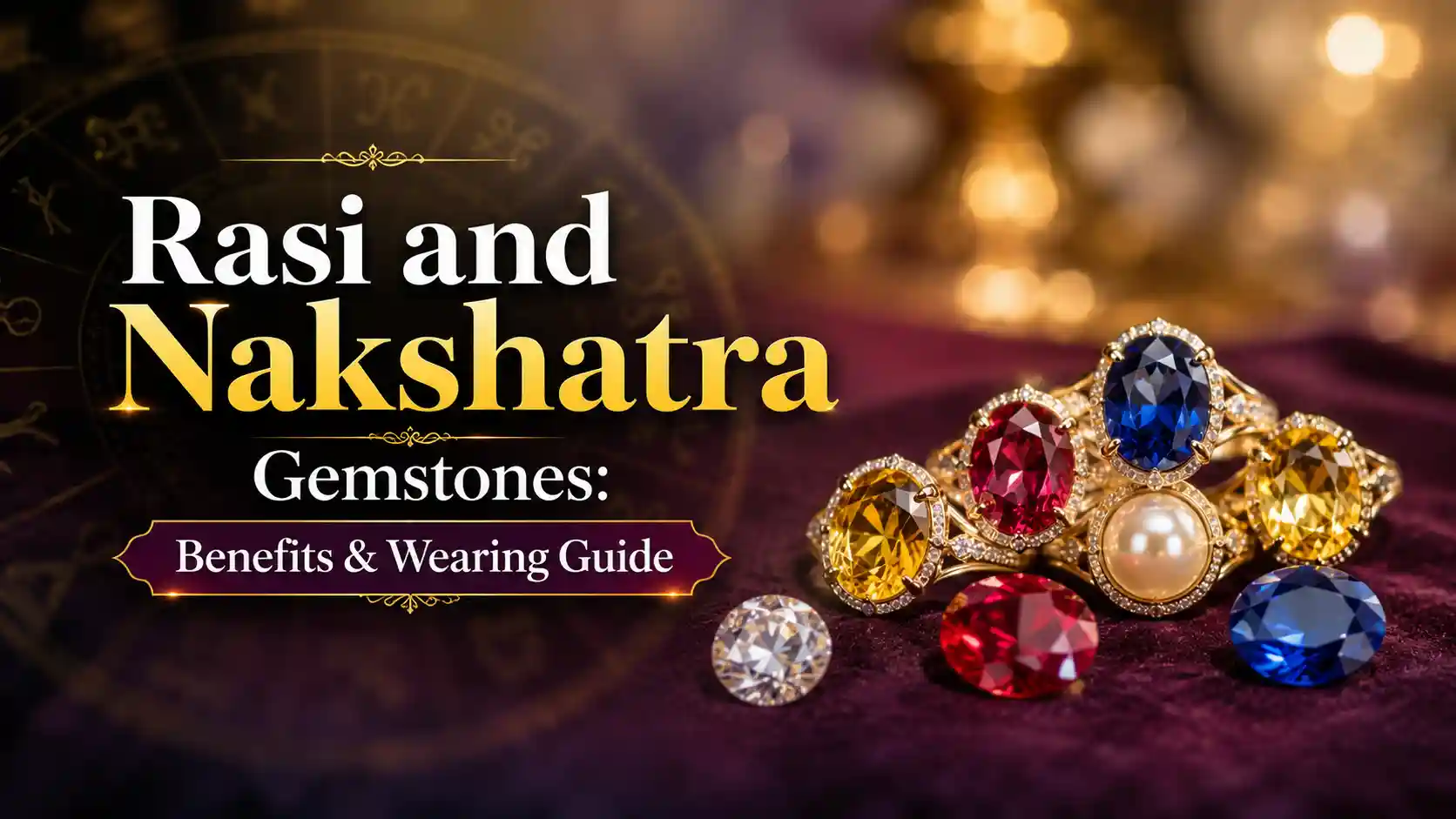
For example, gemstones such as ruby, pearl, red coral, emerald, yellow sapphire, diamond, blue sapphire, hessonite, and cat’s eye are traditionally associated with different planets.
However, simply knowing your Rasi or Nakshatra does not always provide enough information to decide which gemstone is suitable.
Your complete birth chart can provide a much more personalised picture.
Why Is Rasi Important When Choosing a Gemstone?
Rasi plays an important role in many areas of Vedic astrology.
Since the Moon represents the mind, emotions, habits, and inner responses in traditional astrology, the Moon’s sign is often considered when understanding a person’s emotional nature and tendencies.
Some gemstone traditions therefore use Rasi as an initial reference point.
For instance, a person may search for a gemstone based on their Moon sign and find a traditional recommendation online. That can be useful as general information, but it should not automatically be taken as a personal prescription.
The same Rasi can occur in many different birth charts, and the planetary positions can be completely different.
This is one reason experienced astrologers usually look beyond the Rasi alone.
What Is the Role of Nakshatra?
Nakshatra adds another layer to the traditional interpretation.
There are 27 Nakshatras in Vedic astrology, and each Nakshatra is associated with a planetary ruler. Your birth Nakshatra is determined by the position of the Moon at the time of birth.
For example, Ashwini is traditionally ruled by Ketu, while Bharani is ruled by Venus. Rohini is associated with the Moon, and Mrigashira is associated with Mars.
Because each Nakshatra has its own planetary association, some traditional gemstone recommendations are made by considering the Nakshatra lord.
But again, this does not mean that everyone born under the same Nakshatra should automatically wear the same stone.
The strength, placement, ownership, and overall condition of the planet in the birth chart are traditionally considered before making a personal recommendation.
Rasi vs Nakshatra: Which One Matters More?
This is one of the most common questions people ask.
The simple answer is: both can be considered, but neither should necessarily be used in isolation.
Rasi gives an important Moon-sign reference.
Nakshatra provides a more specific lunar constellation and its planetary ruler.
The complete horoscope can then add further details about planetary strength, house placement, conjunctions, aspects, and other traditional astrological factors.
Think of it this way:
Rasi gives you a broad picture.
Nakshatra adds more detail.
The birth chart provides the wider context.
This is why two people with the same Rasi or Nakshatra may receive different gemstone recommendations.
Traditional Gemstones and Their Planetary Associations
In traditional Vedic astrology, certain gemstones are commonly associated with the Navagrahas.
Ruby – Sun
Ruby is traditionally associated with the Sun.
It is often connected with qualities such as confidence, leadership, recognition, authority, and vitality in astrological traditions.
Pearl – Moon
Pearl is traditionally associated with the Moon.
It is commonly linked with emotional balance, calmness, sensitivity, and mental peace in traditional interpretations.
Red Coral – Mars
Red coral is associated with Mars.
Traditional astrology connects it with courage, determination, physical energy, initiative, and confidence.
Emerald – Mercury
Emerald is associated with Mercury.
It is traditionally connected with communication, intelligence, learning, analytical thinking, business skills, and practical decision-making.
Yellow Sapphire – Jupiter
Yellow sapphire is traditionally associated with Jupiter.
It is often linked with wisdom, knowledge, prosperity, guidance, education, and spiritual growth in traditional Vedic astrology.
Diamond – Venus
Diamond is associated with Venus.
Traditional interpretations connect Venus with beauty, relationships, comforts, artistic interests, luxury, and material enjoyment.
Blue Sapphire – Saturn
Blue sapphire is associated with Saturn.
This is one gemstone that is traditionally approached with particular care because Saturn is considered a powerful planet in Vedic astrology.
Traditional practitioners generally recommend checking the birth chart carefully before wearing blue sapphire.
Hessonite – Rahu
Hessonite garnet is traditionally associated with Rahu.
It is connected in traditional astrology with ambition, unconventional experiences, sudden changes, foreign connections, and material desires.
Cat’s Eye – Ketu
Cat’s eye is associated with Ketu.
Traditional interpretations connect Ketu with spirituality, detachment, intuition, inner exploration, and a search for deeper meaning.
Should You Choose a Gemstone Based Only on Your Rasi?
It is better to be cautious here.
You may find lists online saying that a particular gemstone is suitable for a particular Rasi. Such lists can be useful for learning the basics, but they are usually general recommendations.
A gemstone that is considered favourable for one person with a particular Rasi may not necessarily be suitable for another person with the same Rasi.
Why?
Because the rest of the horoscope matters.
The Lagna, planetary ownership, house positions, conjunctions, aspects, planetary strength, and current planetary periods can all change the traditional interpretation.
So, if you are planning to spend a significant amount on an astrological gemstone, it is sensible to have your birth chart reviewed rather than relying only on a generic Rasi chart.
Can Your Nakshatra Help Select a Gemstone?
Yes, traditionally it can be one of the factors.
Your Nakshatra lord is an important consideration in Vedic astrology. Some astrologers use this planetary connection when assessing gemstone suitability.
For example, if your birth Nakshatra is ruled by Venus, Venus-related gemstone traditions may become relevant.
But this still does not mean that a Venus gemstone is automatically suitable.
The astrologer may first examine how Venus is placed in the individual birth chart and whether strengthening that planetary influence is traditionally considered beneficial.
That small difference is important.
A gemstone should ideally be selected for the individual, not simply for the label of the Nakshatra.
How Are Astrological Gemstones Traditionally Worn?
Traditional gemstone practices can vary between astrologers and regions.
The stone may be set in a particular metal and worn on a specific finger. Some traditions also consider the day, time, mantra, purification rituals, and planetary association before wearing the gemstone.
The recommended finger and metal can differ depending on the planet and the specific astrological system being followed.
For this reason, it is better not to copy another person’s gemstone-wearing method without checking whether the same recommendation applies to you.
The quality and authenticity of the gemstone are also important practical considerations.
If you are buying an expensive gemstone, ask for proper certification and purchase from a trustworthy seller.
Does a More Expensive Gemstone Give Better Results?
Not necessarily.
A common misconception is that a more expensive gemstone must automatically provide stronger astrological benefits.
Traditional gemstone practices generally place importance on the stone’s natural quality, clarity, colour, origin, treatment, and suitability for the individual.
From a practical perspective, you should also consider whether the gemstone is genuine and whether the seller provides reliable certification.
Do not feel pressured into buying an extremely expensive stone simply because someone says that a higher price guarantees better results.
What Should You Check Before Buying a Gemstone?
Before purchasing an astrological gemstone, take a few practical steps.
First, confirm your birth details.
An accurate birth date, birth time, and birthplace are important if the gemstone recommendation is based on a horoscope.
Second, understand why the gemstone is being recommended.
Ask which planet it represents and what traditional astrological reason supports the recommendation.
Third, check the gemstone’s authenticity.
For valuable gemstones, certification can help establish whether the stone is natural, treated, synthetic, or imitation.
Fourth, compare the recommendation with your birth chart.
Do not rely entirely on a generic Rasi or Nakshatra list.
Finally, consider your budget.
A spiritual or astrological practice should not create unnecessary financial pressure.
Common Mistakes People Make With Rasi and Nakshatra Gemstones
There are a few mistakes that are easy to make.
1. Choosing a Stone Only by Rasi
Your Rasi is useful, but it is only one part of the traditional astrological picture.
2. Copying Someone Else’s Gemstone
A gemstone recommended for a family member or friend may not be suitable for your horoscope.
3. Buying Without Checking Authenticity
Expensive gemstones can have significant differences in quality and treatment. Certification is worth considering.
4. Wearing Multiple Strong Gemstones Without Guidance
Some people wear several planetary gemstones together without understanding their traditional combinations.
It is better to know why each gemstone is being worn.
5. Expecting Instant Results
Traditional astrology does not provide a guaranteed timetable for gemstone-related results. Claims of immediate wealth, marriage, health recovery, or guaranteed success should be treated carefully.
Rasi and Nakshatra Gemstones: A More Personal Approach
Gemstones have remained part of traditional astrology for generations, and many people continue to wear them as a form of spiritual or astrological practice.
At the same time, choosing one should not become a rushed decision.
Your Rasi can provide a starting point. Your Nakshatra can add another layer of information. Your complete birth chart can offer a more personalised traditional interpretation.
That is why a thoughtful approach is usually better than simply searching for a “best gemstone for my Rasi” and buying the first stone that appears.
If you are genuinely interested in gemstone astrology, take the time to understand why a particular stone is recommended, which planet it represents, and how that planet is traditionally interpreted in your horoscope.
Rasi and Nakshatra gemstones are an interesting part of Vedic astrology, especially for people who enjoy exploring the connection between birth details, planets, and traditional spiritual practices.
There is no need to rush into buying a gemstone.
Start with your Rasi and Nakshatra, understand their traditional planetary connections, and then look at the complete birth chart if you want a personalised recommendation.
Most importantly, treat gemstone astrology as a traditional belief system rather than a guaranteed solution to life’s problems.
A gemstone can be meaningful as a spiritual symbol, a personal reminder, or part of a long-standing cultural tradition. The real value comes from understanding the tradition behind it rather than simply wearing a stone because someone said it would change your life.
Frequently Asked Questions
Which gemstone is best according to Rasi?
There is no single gemstone that can be considered universally best for everyone born under a particular Rasi. Traditional Vedic astrology considers the individual birth chart before recommending a gemstone.
Can I choose a gemstone according to my Nakshatra?
Nakshatra can be used as one traditional factor when selecting a gemstone. The Nakshatra lord and its position in the birth chart may also be considered.
Is Rasi enough to choose a gemstone?
Rasi can provide a general reference, but it may not be enough for a personalised gemstone recommendation. Traditional astrologers often examine the complete birth chart.
Can I wear two gemstones together?
Some gemstone combinations are traditionally considered compatible, while others may require caution. It is better to check the planetary relationships in your individual horoscope before combining gemstones.
Which gemstone is associated with Rahu?
Hessonite garnet is traditionally associated with Rahu in Vedic astrology.
Which gemstone is associated with Ketu?
Cat’s eye is traditionally associated with Ketu.
Should I buy an expensive gemstone?
Price alone does not determine suitability. If you are purchasing a valuable gemstone, consider authenticity, certification, quality, and whether the stone is traditionally suitable for your horoscope.
Rasi and Nakshatra can help you understand traditional gemstone associations, but the complete birth chart gives a more personalised perspective. Choose carefully, verify the gemstone’s authenticity, and approach astrological gemstone practices with informed judgment.