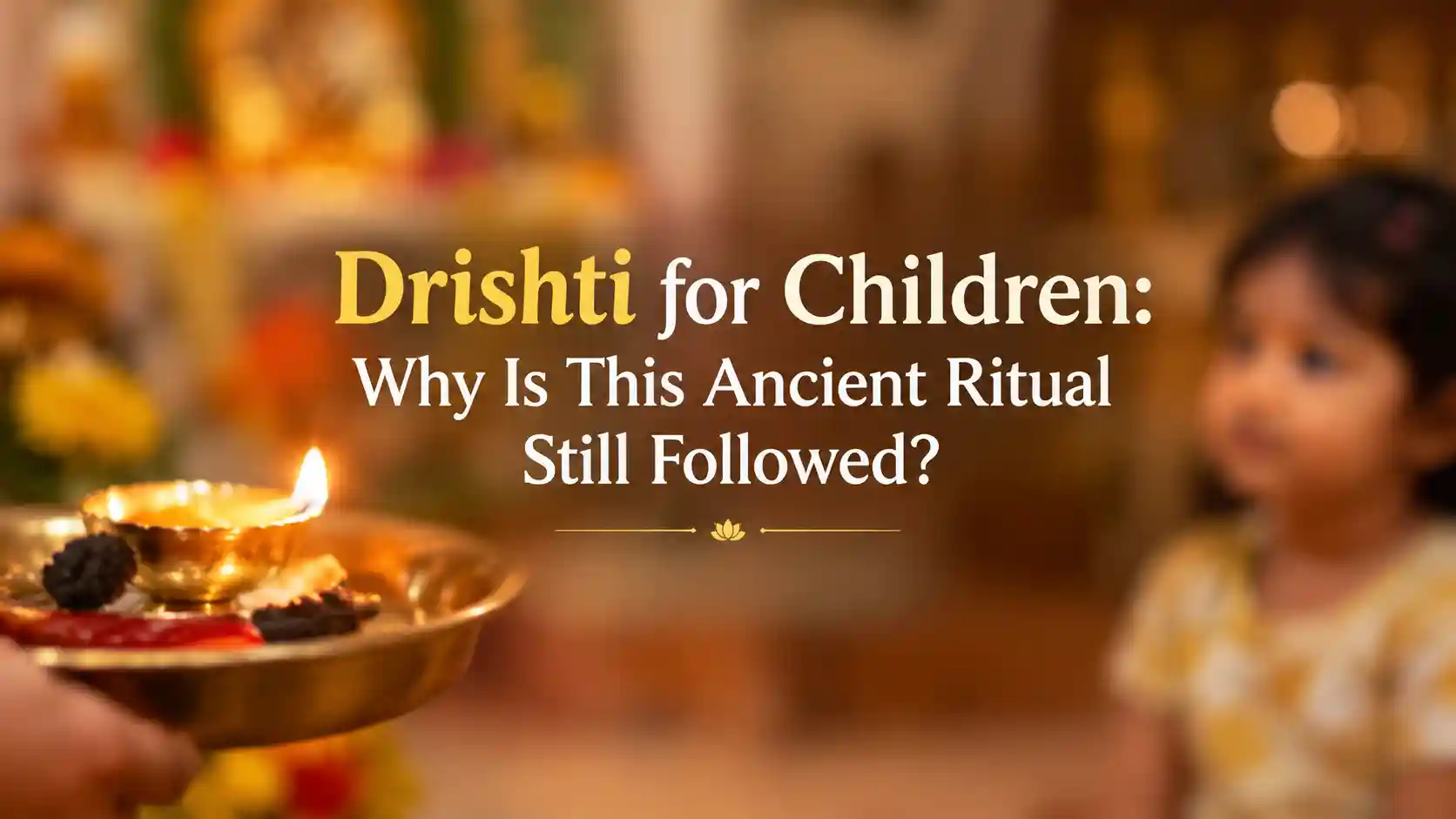
Have you ever noticed something familiar in Indian homes?
A baby is dressed beautifully.
Everyone gathers around.
The little one receives endless compliments…
And then someone quietly says:
Why?
Why do grandparents and parents perform drishti kazhithal for children?
Is it simply an old custom?
Or does this tiny ritual carry a deeper spiritual meaning passed down through generations?
Let’s uncover the fascinating story behind this ancient tradition.
What Exactly Is “Drishti”?
The Sanskrit word “drishti” broadly relates to sight or gaze. In traditional Indian belief, drishti or nazar refers to the idea that an intense or negative gaze—often associated with jealousy, envy, or excessive attention—may bring unwanted influence or misfortune.
This is a cultural and spiritual belief, not a scientifically established phenomenon.
Yet the belief has remained deeply woven into family traditions across generations.
And children occupy a very special place in this tradition.
Why Are Children Given Special Protection?
Think about a newborn baby.
Pure innocence.
A joyful smile.
Tiny hands.
A completely new presence in the family.
Everyone naturally wants to look at the baby, admire the baby and shower the child with affection.
Traditional belief interprets this intense attention as one reason children may be especially protected from drishti.
Historical records from Indian traditions specifically describe children as objects of special concern in evil-eye beliefs.
So the ritual became more than a custom.
It became a symbolic expression of love and protection.
The Mystery Behind the Little Black Dot
Have you ever wondered why some families place a small black mark on a child’s cheek or forehead?
That tiny dot has a fascinating traditional explanation.
In some communities, black is considered a protective or contrasting element, and the mark is traditionally believed to divert or guard against drishti. Studies documenting Indian childhood practices have recorded the use of black dots or black threads for this purpose.
There is also a symbolic idea hidden here:
“Let the child remain protected rather than becoming the centre of excessive admiration.”
It is a small mark…
But to a family following the tradition, it can carry a big emotional meaning.
What Happens During Drishti Kazhithal?
Different families follow different customs.
Some use salt, chillies, camphor, or other traditional objects. In certain traditions, these are symbolically moved around the child and then discarded or otherwise ritually removed.
The exact method varies greatly by region, community and family tradition.
So there isn’t one universal “correct” drishti ritual.
The important element is often the intention behind it:
- Protection.
- Prayer.
- Affection.
- Faith.
Historical documentation shows that such practices have existed in different forms across Indian communities.
Is Drishti Really About Fear?
Not necessarily.
For many families, the ritual is less about fear and more about protective affection.
A grandmother may perform it because her grandmother did the same.
A mother may do it while silently praying:
“May my child always be safe and happy.”
That emotional intention is an important part of why traditions survive.
The ritual becomes a moment when love takes a spiritual form.
The Spiritual Meaning Behind the Ritual
Indian spiritual traditions often place importance on ideas such as:
- Shakti – sacred power
- Raksha – protection
- Sankalpa – a heartfelt intention
- Mangalam – auspiciousness
- Prarthana – prayer
- Kavacham – a symbolic shield or protection
Seen through this spiritual lens, drishti kazhithal can be understood as a symbolic act of protection and prayer.
The family is not merely performing an action.
They are expressing a wish:
“May this child remain surrounded by positivity, blessings and divine grace.”
Why Has This Tradition Survived for So Long?
This is perhaps the most interesting question.
Many old customs disappear with time.
But drishti rituals continue in numerous families.
Why?
Because traditions are not always preserved through books.
They are preserved through people.
A grandmother teaches a mother.
A mother teaches the next generation.
And a simple ritual becomes part of family memory.
The objects may change.
The method may change.
But the underlying emotion remains:
“Protect what we love.”
Drishti and the Power of Intention
There is another beautiful spiritual perspective.
Whether or not someone personally believes in the supernatural aspect of drishti, the ritual can create a moment of mindful intention.
The family pauses.
They focus on the child.
They pray.
They express gratitude.
They wish for the child’s wellbeing.
In that sense, the ritual becomes a small reminder that love itself can be expressed through prayer and intention.
Tradition Meets Modern Understanding
It is important to remember one thing.
If a child becomes unwell, unusually sleepy, has difficulty breathing, has persistent fever, is not feeding properly, or shows any other concerning symptom, traditional rituals should never replace medical care.
Drishti is a traditional belief, not a medical diagnosis.
The beauty of tradition is not that it must replace modern care.
It can coexist with care, compassion and common sense.
The Little Ritual With a Big Story
So, the next time you see a tiny black dot on a child’s cheek…
or hear someone say,
“Let’s remove the drishti…”
remember that you are looking at more than an everyday custom.
You are seeing a tradition shaped by generations of faith, affection, symbolism and the desire to protect the innocent.
Perhaps that is why it continues.
Not because every generation follows everything blindly…
but because some traditions carry an emotion people don’t want to lose.
A child’s smile brings joy.
A family’s prayer surrounds that joy with love.
And perhaps the deepest meaning of drishti kazhithal is beautifully simple:
“May the little one always walk under the shadow of blessings.”