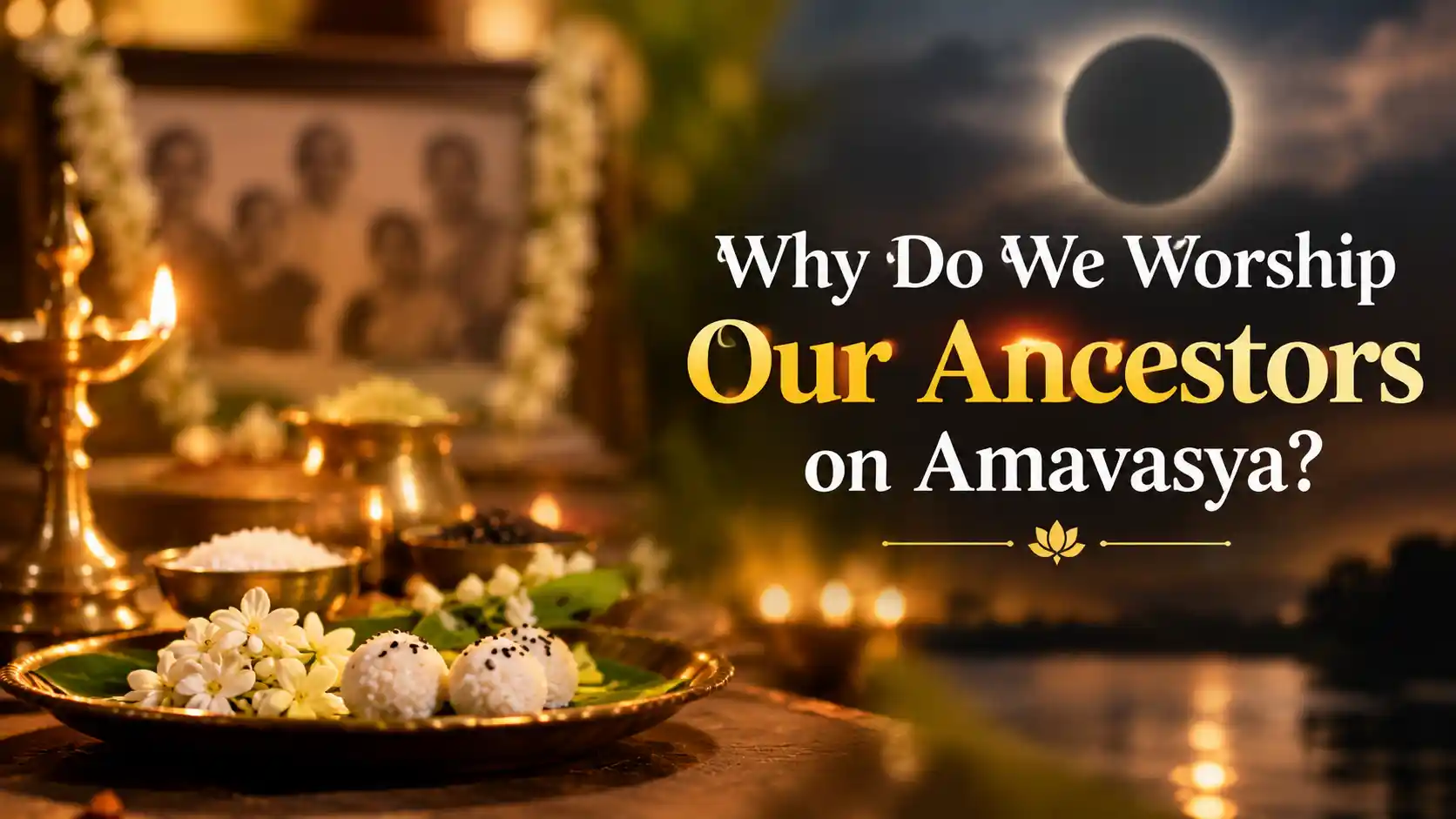
There are some days in our tradition that feel different from ordinary days. Amavasya, the new moon day, is one of them.
For many families, Amavasya is a day to remember their ancestors, offer prayers, and express gratitude for the people who came before them.
You may have seen elders in your family doing a simple prayer, lighting a lamp, offering food, or visiting a temple on Amavasya. Sometimes, we follow these practices because our parents and grandparents followed them. But have you ever wondered why ancestors are remembered especially on Amavasya?
The tradition is not only about rituals.
At its heart, it is about gratitude, remembrance and family bonds that continue across generations.
What Does Ancestor Worship Mean?
Ancestor worship, often called Pitru worship or Pitru remembrance, is a traditional practice of remembering deceased parents, grandparents and other ancestors with respect.
In Hindu traditions, ancestors are often remembered through prayers, offerings and charitable acts.
It does not necessarily have to be complicated.
For some families, it may mean performing a traditional ritual with the help of a priest. For others, it may simply mean lighting a lamp at home, remembering their ancestors and offering a sincere prayer.
The form may differ from family to family, but the feeling behind it remains the same:
“We remember those who came before us, and we are grateful for what they gave us.”
Why Is Amavasya Considered Important for Ancestor Worship?
Amavasya is the day when the moon is not visible in the night sky.
In traditional Hindu belief, this day has a special connection with Pitru worship and remembrance of ancestors. This is why many families consider Amavasya an appropriate time to offer prayers and rituals for their departed family members.
There is also a simple emotional side to this tradition.
The new moon night is naturally quiet and dark. Such a setting can encourage us to slow down, look inward and remember the people and values that shaped our lives.
So, for many devotees, Amavasya becomes a monthly reminder:
Do not forget where you came from.
What Can We Do for Our Ancestors on Amavasya?
The exact practice depends on your family tradition.
Some families perform Tarpanam, offer food, visit a temple, or perform other Pitru-related rituals.
If your family already follows a particular Amavasya ritual, it is generally best to continue that tradition rather than suddenly changing it.
For those who do not follow an elaborate ritual, a simple prayer at home can also become a meaningful act of remembrance.
You can:
- Light a lamp in a clean prayer space.
- Remember your parents, grandparents and ancestors with gratitude.
- Offer a simple prayer according to your family tradition.
- Prepare food and offer it as part of your customary practice.
- Donate food or help someone in need in memory of your ancestors.
- Spend a few quiet moments remembering the good values they passed on to your family.
The important thing is not to turn the day into a competition about who performs the biggest ritual.
Sincerity matters more than show.
Is It Necessary to Perform a Big Ritual?
Not every family follows the same practice.
Some people may perform traditional Pitru rituals with a priest. Others may observe Amavasya in a much simpler way.
If you are unsure about what your family traditionally does, speaking to an elder in the family can be helpful. They may know the customs that have been followed for generations.
There is no need to feel guilty simply because you cannot perform an elaborate ritual.
If circumstances do not allow it, you can still take a few minutes to remember your ancestors with respect.
A simple prayer can come from the heart:
“May the souls of our ancestors be at peace. May we always remember the good values they gave our family.”
Why Do Some Families Offer Food?
Offering food to ancestors is an important part of several traditional practices.
Food represents care, gratitude and sharing. In many families, food is prepared with respect and offered as part of the customary ancestor ritual.
There is also another beautiful practice associated with remembrance — feeding others or donating food in memory of ancestors.
A meal given to someone who needs it can turn remembrance into an act of kindness.
It reminds us that remembering our ancestors is not only about looking into the past. Their memory can also inspire us to do something good in the present.
What About Visiting a Temple on Amavasya?
Some people choose to visit a temple on Amavasya and offer prayers.
Others may prefer to perform their family rituals at home or at a traditional place associated with their ancestors.
There is no need to compare one person’s practice with another.
Temple worship, home prayer, Tarpanam and charitable acts may all have a place within different family traditions.
Follow the practice that is appropriate for your family and tradition.
Can We Remember Ancestors Without Knowing All the Rituals?
Yes, you can remember them respectfully even if you do not know every ritual.
Sometimes people hesitate because they think they need to know a particular mantra or procedure.
But remembrance does not have to begin with complicated words.
Take a few minutes.
Light a lamp.
Sit quietly.
Remember your parents, grandparents or ancestors.
Think about the sacrifices they may have made, the lessons they taught, and the values they left behind.
Even that quiet moment can become meaningful.
A Simple Amavasya Prayer at Home
If you are unable to perform a traditional ritual, you can keep your prayer simple and respectful.
Clean the prayer area and light a lamp.
Take a few moments to remember your ancestors.
You can say a prayer in your own words or follow the prayer traditionally used by your family.
If possible, prepare or share food as your family custom allows.
You can also help someone in need or offer food to others in memory of your ancestors.
Then sit quietly for a moment.
There is no need to rush.
Sometimes, remembering someone quietly can say more than a long prayer.
Amavasya Is Also a Day to Remember Our Roots
Modern life moves quickly.
We are busy with work, children, responsibilities and countless everyday tasks. In between all of this, it is easy to forget the people whose lives made ours possible.
That is why traditions such as Amavasya ancestor worship continue to hold meaning for many families.
It gives us a reason to pause.
To remember.
To say thank you.
And perhaps, to think about what kind of values we want to pass on to the next generation.
Because one day, we too will become part of someone’s family story.
What Is the Spiritual Meaning Behind Ancestor Remembrance?
From a spiritual perspective, remembering ancestors is connected with gratitude and respect for one’s lineage.
Our family history is not only a list of names and dates.
It carries stories, struggles, traditions, mistakes, sacrifices and values.
When we remember our ancestors, we also remember those lessons.
Perhaps that is one of the most meaningful parts of the tradition.
We are not simply looking backward.
We are carrying something forward.
Final Thoughts
Amavasya ancestor worship is an old tradition, but its central feeling is something anyone can understand.
Remember the people who came before you.
Be grateful for what they gave you.
Respect your family traditions.
And when possible, turn that remembrance into a good deed.
You may light a lamp, perform a traditional ritual, offer food, visit a temple, donate to someone in need, or simply sit quietly and remember your ancestors.
The ritual may be simple or elaborate.
But the feeling behind it can remain the same:
“You may no longer be with us, but we have not forgotten you.”
That remembrance itself can become a quiet form of gratitude.