Not every culturally important plant looks extraordinary. Some have bright flowers, a distinctive fragrance, or a dramatic appearance. Others grow quietly beneath our feet and are so familiar that people rarely stop to think about them.
Bermuda grass, scientifically known as Cynodon dactylon, belongs to the second category.
In Tamil culture, it is widely known as Arugampul, and it occupies an interesting placeat the intersection of religious practice, traditional knowledge, ecology, and everyday life. To someone unfamiliar with its cultural background, it may appear to be nothing more than a spreading grass. Yet for generations, it has been collected for worship, discussed in traditional healing practices, and valued for some of its environmental characteristics.
Its importance is therefore not based on a single reason. Arugampul represents a larger idea found throughout Indian culture: something does not need to be rare, expensive, or visually impressive to be considered valuable.
A Special Connection With Lord Ganesha
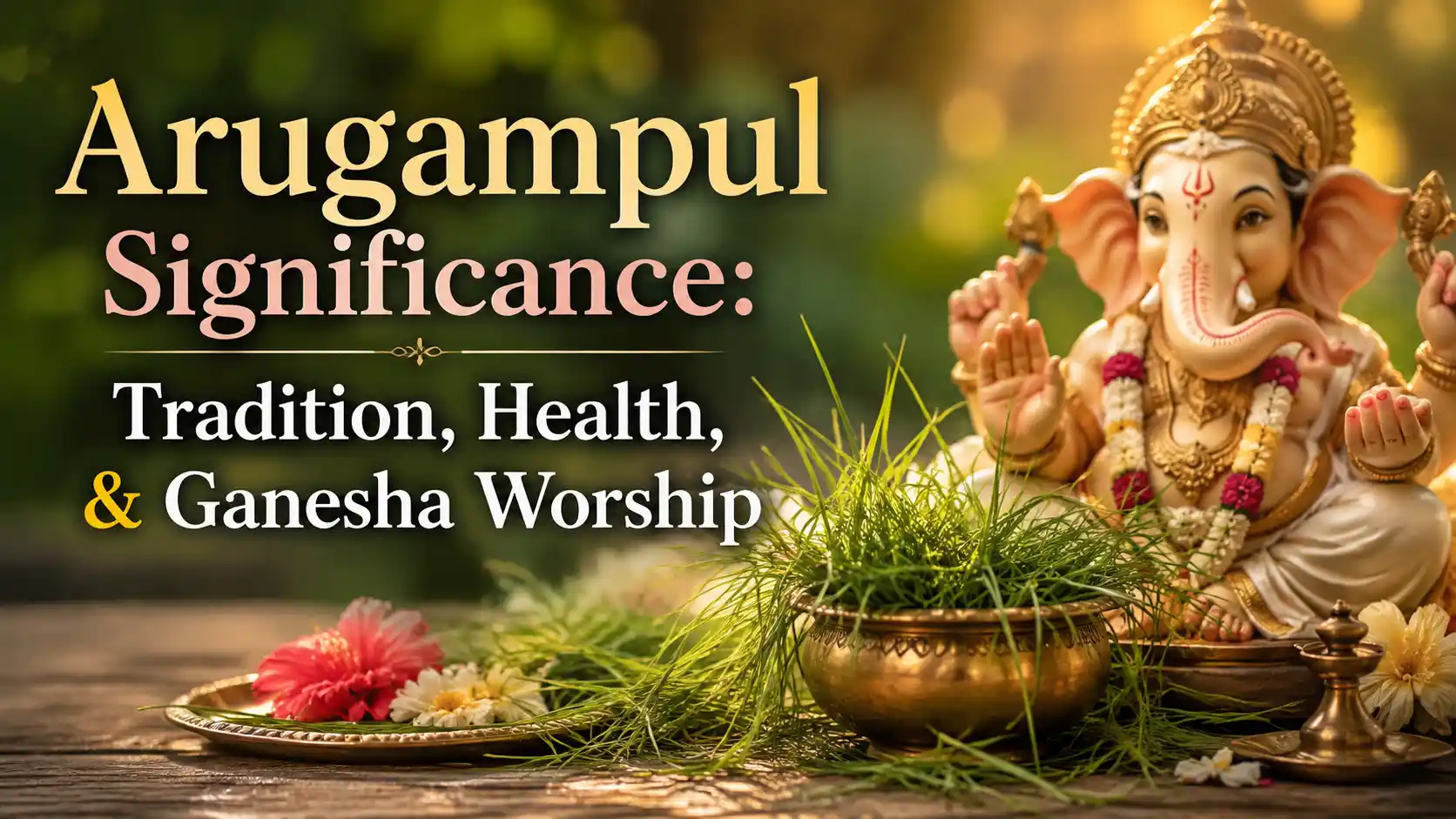
One of the strongest cultural associations of Arugampul is with the worship of Lord Ganesha. In many Hindu traditions, grass offerings known as durva are associated with Ganesha worship.
The precise ritual practices and stories may differ between communities, but the underlying symbolism remains significant. A simple blade of grass can become part of an act of devotion.
This is particularly interesting in a world where value is often connected with price. Religious offerings are not always about giving the most expensive object available. In many traditions, intention, symbolism, and cultural meaning are equally important.
Arugampul therefore represents a form of sacred simplicity.
During Vinayagar Chaturthi and other Ganesha-related observances, devotees may include this grass among their offerings. The practice connects modern households with traditions that have been maintained over many generations.
The Cultural Value of Simplicity
There is an important philosophical lesson hidden in the cultural status of Bermuda grass.
People tend to notice what stands out. Rare flowers attract attention. Large trees inspire admiration. Expensive products are often treated as symbols of success.
Grass, by comparison, is easy to overlook.
Yet Arugampul has survived in cultural memory precisely because usefulness and meaning are not always connected with visual beauty. It can grow close to the ground, spread across open spaces, and survive conditions that may be difficult for more delicate plants.
In a symbolic sense, this resilience may explain why ordinary natural objects often become powerful cultural symbols. They are familiar. They belong to everyday landscapes. People encounter them repeatedly throughout their lives.
The cultural importance of Arugampul encourages a useful question: how many valuable things do we ignore simply because they appear ordinary?
Arugampul in Traditional Healing Practices
For centuries, plants have been part of traditional healing systems across India. Arugampul is among the plants that appear in folk practices and discussions related to traditional remedies.
Some people traditionally prepare extracts or juices from the plant, while others use it in external applications. In popular health discussions, it is sometimes described as cooling or cleansing.
However, this is where careful distinction becomes essential.
A long history of traditional use does not automatically prove that every claimed health benefit has been scientifically established. Plants contain complex natural compounds, and some may have biological activity. But determining whether a substance is safe, effective, and useful for a specific medical condition requires systematic research.
This means claims such as “Bermuda grass cures every disease” or “Arugampul juice can replace medical treatment” should be treated with skepticism.
Traditional knowledge can be worth studying and preserving, but serious illness should not be self-treated based solely on social media claims or unverified advice.
Anyone taking medication, managing a chronic health condition, or considering regular consumption of herbal preparations should seek advice from an appropriately qualified healthcare professional.
A Grass With Environmental Functions
The importance of Bermuda grass is not limited to culture and traditional practices. Like many ground-covering plants, it can also play an environmental role.
Its growth pattern and root system can help cover exposed soil. Ground cover is important because bare soil can be vulnerable to erosion caused by rain and wind. In suitable locations, vegetation may help stabilize the surface and reduce direct soil exposure.
Bermuda grass is also known for its ability to establish itself and spread under favorable conditions. This characteristic makes it useful in some landscaping and turf settings.
However, rapid growth can have two sides.
A plant that spreads effectively may be useful where ground cover is needed, but it may also require management if it begins competing with other plants. Whether Bermuda grass is considered desirable or problematic can depend greatly on the environment and how the land is being used.
This is an important ecological principle: a plant is not universally “good” or “bad.” Context matters.
What Traditional Knowledge Can Teach Us
Modern society often separates knowledge into categories. There is scientific knowledge, religious knowledge, cultural knowledge, agricultural knowledge, and medical knowledge.
Traditional societies did not always maintain such sharp boundaries.
A single plant could have a role in rituals, household practices, farming, and folk medicine. Arugampul is an example of this interconnected relationship between people and the natural environment.
Studying these traditions does not mean accepting every historical claim without question. Instead, it means understanding why certain plants became culturally important and asking what evidence supports their different uses.
For example, a religious tradition can be culturally meaningful without requiring scientific proof. A medical claim, however, should be evaluated using scientific evidence.
Keeping these categories clear allows us to respect tradition without abandoning critical thinking.
The Importance of Safe Collection
If Arugampul is being collected for religious or other traditional purposes, cleanliness matters. Grass growing beside polluted roads, industrial areas, sewage channels, or heavily treated agricultural land may be exposed to contaminants.
This is especially important when people plan to consume plant material.
The assumption that “natural” automatically means “safe” is not always correct. Plants can absorb substances from their surroundings, and they may also be contaminated by pesticides, microbes, or other environmental pollutants.
The source of a plant can therefore matter as much as the identity of the plant itself.
Growing plants in a controlled home environment may provide greater confidence about where they came from, although safe handling and proper identification remain important.
Arugampul and the Continuity of Family Traditions
Many people first learn about culturally significant plants from older family members. A grandmother may explain why a particular leaf is used in prayer. A parent may collect a specific plant before a festival. A child may initially follow the practice without understanding the story behind it.
Years later, those small memories become part of cultural identity.
Arugampul is one of those plants that can connect generations. It may not be the same physical grass that survives from one generation to the next, but the knowledge about it does.
That continuity is valuable.
In a rapidly changing world, traditions provide a form of cultural memory. They tell people how previous generations understood nature and incorporated it into daily life.
The goal should not necessarily be to preserve every tradition without examination. Rather, traditions can be preserved, questioned, researched, and understood.
A Balanced Way to View Arugampul Today
There are two common extremes when discussing traditional plants.
The first is complete dismissal: the belief that anything associated with traditional practice must be irrational or useless.
The second is unquestioning belief: the assumption that anything used by previous generations must be scientifically proven and capable of solving modern health problems.
Neither approach is particularly useful.
A more balanced perspective recognizes multiple dimensions. Arugampul has genuine cultural significance. It has a documented identity as a plant species. It has ecological characteristics that can make it useful in certain environments. It also has a history of traditional use that may deserve scientific investigation.
At the same time, extraordinary medical claims require strong evidence.
This approach allows tradition and scientific inquiry to coexist rather than compete.
Conclusion
Arugampul, or Bermuda grass, demonstrates how an apparently ordinary plant can carry an extraordinary range of meanings.
For devotees, it is connected with religious practice and Ganesha worship. For families, it may be part of traditions passed down through generations. For students of nature, it is a hardy grass with interesting ecological characteristics. For researchers, its traditional uses can raise questions worth investigating scientifically.
Its greatest significance may therefore lie in what it teaches us about value.
Not everything important is rare. Not everything meaningful is expensive. And not every piece of traditional knowledge should be either blindly accepted or casually dismissed.
Sometimes, understanding begins by looking more carefully at the things we see every day.
The cultural association of Cynodon dactylon with Ganesha worship and its identity as Bermuda grass are well established.