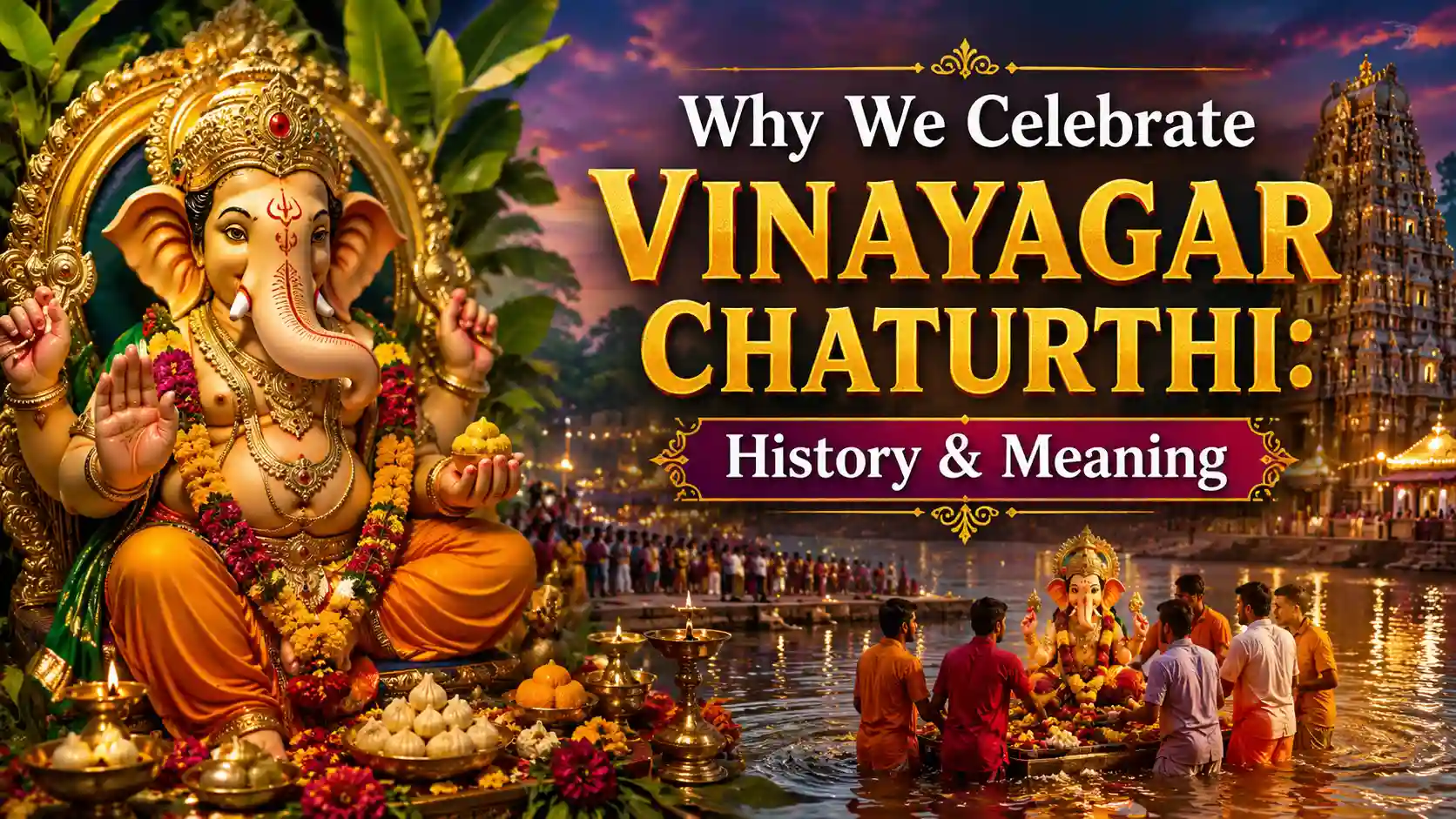
A Festival About Beginnings, Community and Cultural Memory
At first glance, the festival may appear to have a simple purpose: devotees celebrate the birth of Ganesha with prayers, offerings and community gatherings.
But the festival has developed into something much larger.
Inside a single Vinayagar Chaturthi celebration, it is possible to find mythology, family traditions, regional food, public art, music, craftsmanship and environmental conversations. A child may remember the festival because of colourful idols and sweet kozhukattai. An older family member may connect it with religious observance. A community organizer may see it as an opportunity to bring people together.
This ability to carry different meanings for different generations is one reason the festival continues to thrive.
Who Is Lord Ganesha?
Ganesha is known by many names, including Vinayagar, Pillaiyar, Ganapati and Vighneshwara. He is one of the most widely recognized figures in Hindu traditions and is immediately identifiable through his elephant head.
In many Hindu communities, Ganesha is invoked before the beginning of important activities. People may pray before starting a new business, moving into a new home, beginning an educational journey or undertaking another important task.
The association with new beginnings is especially interesting because beginnings are naturally uncertain.
Starting something new means accepting that obstacles may appear. No prayer, plan or preparation can guarantee that life will proceed without difficulty. But rituals connected with beginnings can provide a moment to pause, focus and approach the next stage with intention.
For believers, this is an act of devotion. For others, it can also be understood as a symbolic reminder to begin with awareness and preparation.
The Traditional Story of Ganesha’s Birth
Several versions of Ganesha’s origin story exist across Hindu texts and traditions. One of the best-known narratives describes Parvati creating a young boy and placing him at the entrance while she wished to remain undisturbed.
When Shiva arrived, the boy did not recognize him and refused to allow him to enter. A conflict followed, and in the story’s most dramatic moment, the boy was fatally injured. Later, he was restored to life with the head of an elephant and became Ganesha.
Different traditions tell this story in different ways, and the details may vary. That diversity is itself an important feature of Hindu mythology. Stories have travelled through regions, languages and generations, often developing new interpretations.
Rather than looking for only one version, it can be useful to understand mythology as a living cultural tradition with multiple layers of meaning.
Why Is Ganesha Worshipped First?
One of the most common questions surrounding Vinayagar worship is why Ganesha is often honoured before other deities during ceremonies.
The traditional explanation is connected with his role as the remover of obstacles.
But this idea can also be understood in a practical way.
Before beginning an important task, people often try to identify possible problems. They organize resources, prepare mentally and consider what could go wrong. A ritual performed before a major undertaking can create a deliberate moment of focus.
In this sense, the symbolism of Ganesha and the practical psychology of preparation can exist alongside one another.
The festival reminds people that beginning is important, but beginning thoughtfully is even more valuable.
What Happens During Vinayagar Chaturthi?
Celebrations vary widely between homes, temples and public spaces.
In many Tamil households, the day begins with cleaning and decorating the home. A Ganesha idol may be placed in the prayer area and decorated with flowers, leaves and traditional offerings.
Food plays an important role. Kozhukattai is especially associated with Vinayagar Chaturthi, and families may prepare sweet or savoury varieties.
The process of making these foods is often as meaningful as eating them. Traditional recipes involve techniques that are frequently passed through families. A grandparent may teach a younger family member how to prepare the filling. Parents and children may shape the kozhukattai together.
In this way, food becomes a form of cultural education.
Why Is Kozhukattai So Closely Associated With Ganesha?
Ask many Tamil families what food they associate with Vinayagar Chaturthi, and kozhukattai will almost certainly appear near the top of the list.
Traditional stories describe modak or kozhukattai as one of Ganesha’s favourite offerings. Over time, this association became an important part of festival cuisine.
However, the cultural value of the dish extends beyond mythology.
Kozhukattai represents handmade food. It requires preparation, assembly and patience. Unlike opening a packaged snack, the process encourages people to spend time in the kitchen together.
Traditional festival food can therefore preserve more than taste. It preserves methods, vocabulary, family stories and memories.
From Home Celebration to Public Festival
One of the most interesting aspects of Ganesh Chaturthi is how it evolved into a major public event in several parts of India.
The public celebration of Ganesh festivals became particularly prominent in Maharashtra during the late nineteenth century. Nationalist leader Bal Gangadhar Tilak played an important role in promoting large public Ganesh celebrations as spaces where people could gather collectively during the colonial period.
This transformed the festival’s social role.
A celebration that could take place within a home or temple also became a large public expression of community identity.
Today, public celebrations may include artistic idols, music, cultural performances and community activities. The scale varies enormously—from a small neighbourhood gathering to a massive urban celebration.
This history demonstrates that religious festivals are not static. Their social meaning can change as societies change.
The Meaning of Immersion
At the conclusion of many Ganesh Chaturthi celebrations, the idol is ceremonially immersed in water. This practice is often referred to as visarjan.
For devotees, the ritual is connected with the ceremonial departure of Ganesha after the period of worship.
Symbolically, the practice can also be connected with the temporary nature of physical forms.
People welcome. People celebrate. People eventually say goodbye.
This cycle of arrival and departure is part of human life itself.
However, modern celebrations have also raised environmental concerns. Idols made with materials that do not dissolve naturally, along with synthetic paints and other substances, can contribute to water pollution.
As a result, many communities now promote clay idols, natural materials and controlled immersion arrangements.
This does not necessarily weaken tradition. It demonstrates how traditions can respond to new knowledge and changing environmental responsibilities.
The Symbolism of Ganesha’s Form
Ganesha’s appearance has inspired many symbolic interpretations.
His large head is often associated with broad thinking and wisdom. His large ears may represent the importance of listening. His small eyes can symbolize concentration.
His large stomach is sometimes interpreted as the capacity to accept and process the many experiences of life.
Even the contrast between Ganesha’s large form and his traditional association with the mouse as a vehicle has generated symbolic interpretations. It can suggest that strength and usefulness are not determined only by physical size.
These interpretations are not scientific facts, and different traditions may explain the symbols differently. Their value lies in how they encourage reflection.
Religious imagery can often function as a visual language for ideas that are otherwise difficult to communicate.
Why Does the Festival Still Matter Today?
Modern life is increasingly fast-paced and fragmented. Work, technology, travel and individual schedules can make it difficult for families and communities to spend meaningful time together.
Festivals interrupt that routine.
They create occasions for people to gather, prepare food, decorate shared spaces and participate in traditions larger than themselves.
Vinayagar Chaturthi also gives younger generations an opportunity to ask questions.
Why do we perform this ritual?
Where did this story come from?
What does this symbol mean?
How can we celebrate without harming the environment?
These questions should not be seen as threats to tradition. In many ways, questioning is what allows traditions to remain meaningful.
A practice that is understood is more likely to be preserved responsibly than one that is followed without reflection.
Celebrating With Responsibility
Every major public festival creates practical challenges.
Large gatherings can produce waste. Loud sound systems can disturb nearby residents. Traffic can become difficult. Immersion practices can affect water bodies when unsuitable materials are used.
A meaningful celebration should therefore include responsibility.
Using eco-friendly idols, reducing unnecessary plastic, managing waste and respecting public spaces can allow cultural celebrations to continue without placing avoidable pressure on the environment.
This is perhaps one of the most important ways Vinayagar Chaturthi can evolve in the modern era.
Respect for a deity and respect for the natural world do not need to be treated as separate ideas.
Conclusion
Vinayagar Chaturthi is celebrated to honour the birth of Lord Ganesha, but the festival has grown into a rich cultural experience with many layers.
It is about devotion for those who worship. It is about new beginnings for those seeking guidance. It is about family recipes, shared memories and cultural continuity. In public spaces, it can also represent community and collective celebration.
The lasting power of Vinayagar Chaturthi may come from this flexibility.
The festival can remain connected to ancient stories while continuing to respond to modern concerns. It can preserve tradition while encouraging environmental responsibility. It can bring families together while also creating opportunities for younger generations to question, learn and reinterpret.
Ultimately, the celebration is not only about remembering a divine birth.
It is also a reminder that every beginning brings uncertainty, every challenge requires patience, and every tradition remains strongest when people understand the meaning behind what they celebrate.