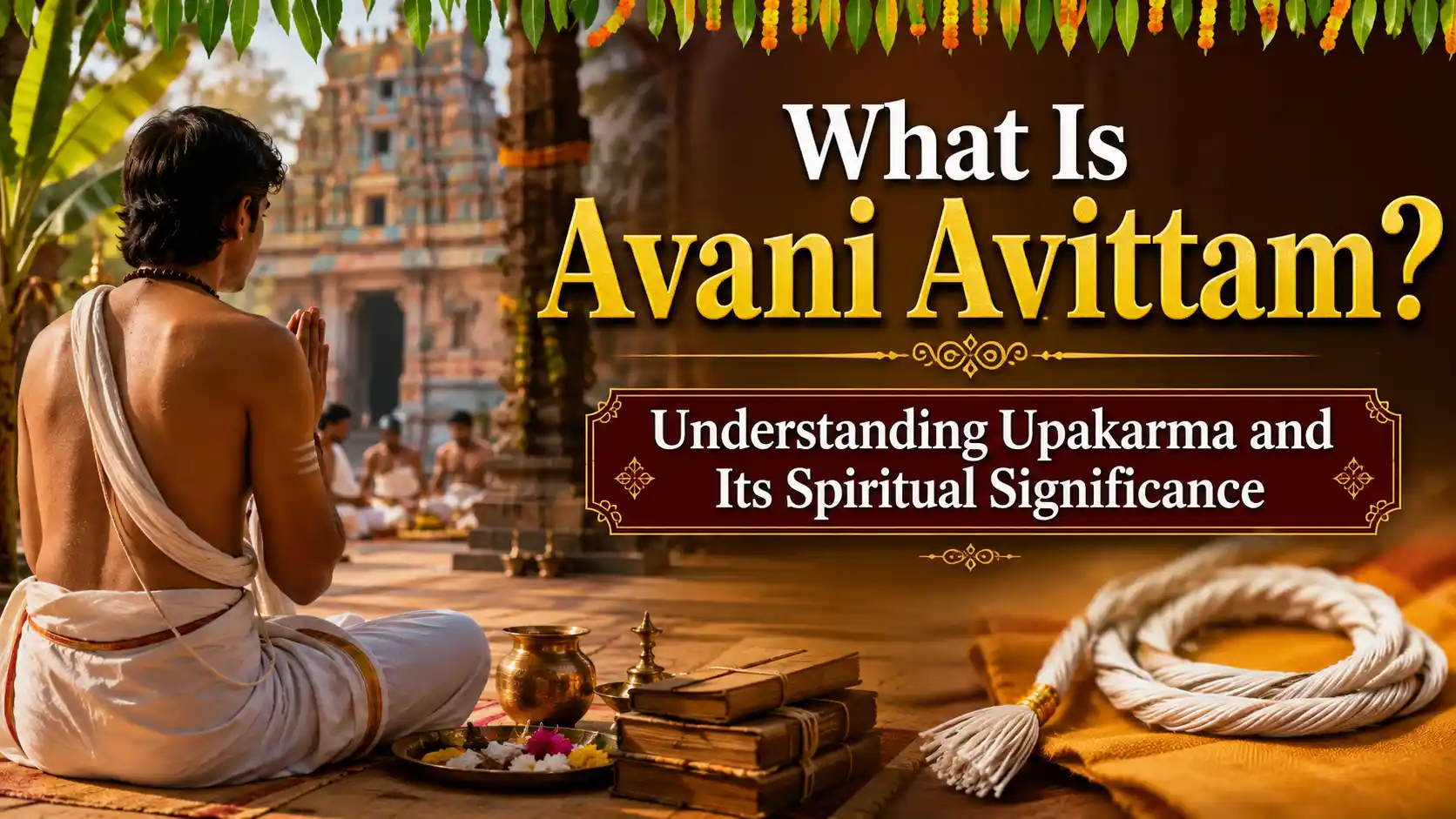
Avani Avittam is one of the important traditional observances associated with Vedic practice in Tamil culture. While many people simply recognize it as the day for changing the sacred thread, its significance goes much deeper.
The observance is connected with Upakarma, a traditional beginning or renewal of Vedic study. It is also associated with remembering the Rishis who preserved Vedic knowledge, performing prescribed rituals, renewing spiritual discipline, and continuing the practice of Gayatri Japa.
For those who follow the tradition, Avani Avittam is therefore not merely a ritual performed once a year. It can be understood as a reminder to renew one’s commitment to knowledge, discipline, and spiritual practice.
What Is Avani Avittam?
Avani Avittam is the traditional observance of Upakarma associated with the Avittam Nakshatra during the month of Avani.
In Tamil Nadu, the term Avani Avittam is commonly associated with the Upakarma followed in the Yajurveda tradition. However, the exact observance and date can vary according to the Vedic tradition, family custom, and local Panchangam.
This is why the appropriate date and ritual timings should be confirmed according to one’s own tradition rather than assuming that the same procedure applies to everyone.
At its heart, Avani Avittam represents a renewal of Vedic learning and spiritual discipline.
What Does Upakarma Mean?
The word Upakarma is understood as a beginning or commencement. In the traditional context, it is associated with beginning or renewing the study of the Vedas.
This gives Avani Avittam a deeper meaning.
It is not simply about replacing an old sacred thread with a new one. The observance reminds the practitioner to renew their commitment to learning, spiritual discipline, and the practices associated with Vedic tradition.
In this sense, Avani Avittam can be viewed as an annual opportunity for spiritual renewal.
Why Is the Sacred Thread Changed on Avani Avittam?
One of the most familiar practices associated with Avani Avittam is the renewal of the sacred thread, or Yajnopavita.
The sacred thread has an important place in the traditional Vedic way of life. Renewing it is therefore regarded not merely as a physical change, but as a symbolic renewal of one’s responsibilities, discipline, and commitment to spiritual learning.
This is why the sacred thread ceremony is traditionally accompanied by appropriate mantras and rituals.
The deeper message is important: changing the sacred thread is only one part of the observance; understanding and following the spiritual discipline associated with it is equally meaningful.
How Is Avani Avittam Observed?
The precise procedure may differ according to Vedic school and family tradition. Traditionally, the observance includes several important stages.
1. Sacred Bath
The day traditionally begins with a sacred bath as preparation for the rituals.
In earlier times, such observances were often performed near rivers, ponds, or other water bodies. Today, families may follow the customary procedure at home or in an appropriate religious setting.
The bath represents preparation and purification before beginning the sacred observance.
2. Ganesha Puja
The rituals may begin with Ganesha Puja, seeking the blessings of Lord Ganesha before undertaking the day’s spiritual practices.
Beginning an important religious observance with prayer to Ganesha reflects the traditional belief in seeking divine grace before commencing a sacred undertaking.
3. Sankalpa
A Sankalpa, or sacred resolve, is made as part of the ritual.
It represents the conscious intention to perform the observance according to tradition. More than simply reciting words, Sankalpa can be understood as a reminder to approach the ritual with awareness and sincerity.
4. Renewal of the Sacred Thread
The old sacred thread is removed and a new one is worn according to the prescribed ritual and mantras.
Although this is the most visible part of Avani Avittam, it should not be mistaken for the entire purpose of Upakarma.
The renewal is symbolic of renewing one’s commitment to spiritual duties and Vedic learning.
5. Rishi Tarpanam
Another important aspect is Rishi Tarpanam, performed in remembrance of the Rishis.
The Vedic tradition has been preserved and transmitted through generations. Remembering the Rishis who safeguarded and transmitted this knowledge expresses gratitude towards that lineage.
This makes Avani Avittam not only a personal observance but also a moment of remembrance and gratitude.
6. Veda Arambham
One of the deeper purposes associated with Upakarma is Veda Arambham — beginning or renewing Vedic study.
The teachings attributed to Kanchi Maha Periyava emphasize that after changing the sacred thread, one should also give importance to Vedic learning and practice. This highlights an important distinction: the significance of Avani Avittam does not end with wearing a new sacred thread.
The observance is meant to reconnect the individual with the discipline and knowledge represented by that sacred thread.
Why Is Gayatri Japa Important After Avani Avittam?
Gayatri Japa is another important practice associated with the observance.
Traditionally, Gayatri Japa is performed on the day following Upakarma. The Gayatri Mantra holds a significant place in Vedic spiritual practice and is traditionally associated with prayer for illumination, clarity, and spiritual awareness.
Traditional accounts of Avani Avittam also describe the practice of performing an extended Gayatri Japa on the following day.
The teachings of Kanchi Maha Periyava similarly place emphasis on the importance of Gayatri Japa and maintaining one’s spiritual discipline beyond the ritual itself.
This offers a valuable perspective for modern life: a spiritual observance becomes more meaningful when its discipline continues beyond a single day.
What Did Kanchi Maha Periyava Teach About Avani Avittam?
The teachings associated with Kanchi Maha Periyava offer an important way of understanding the deeper purpose of Avani Avittam.
The central idea is that changing the sacred thread alone should not be considered the completion of Upakarma.
The observance is connected with Vedic study, Vedic mantras, Veda Arambham, and Gayatri Japa. The sacred thread should therefore remind a person of the responsibilities and spiritual practices associated with it.
This perspective is especially meaningful today.
Modern life can easily turn traditional festivals into routine occasions. We may perform a ritual because it is customary without pausing to understand why it is performed.
The teachings attributed to Kanchi Maha Periyava encourage us to look beyond the external ritual and understand its purpose.
Tradition becomes more meaningful when we understand the wisdom behind it and sincerely follow it.
What Is the Spiritual Significance of Avani Avittam?
The significance of Avani Avittam can be understood through three simple ideas:
Knowledge. Gratitude. Renewal.
Knowledge
Upakarma reminds us of the importance of Vedic learning and the continuous pursuit of knowledge.
Gratitude
Rishi Tarpanam provides an opportunity to remember and express gratitude towards the Rishis and the traditional lineage through which Vedic knowledge has been preserved.
Renewal
The renewal of the sacred thread represents a deeper renewal of one’s commitment to spiritual discipline, learning, and responsibility.
Together, these ideas give Avani Avittam a meaning that goes beyond a single ritual.
Is Avani Avittam Just a Sacred Thread Changing Ceremony?
No.
Changing the sacred thread may be the most familiar part of Avani Avittam, but it is only one element of a broader observance.
Upakarma is associated with renewing Vedic study, remembering the Rishis, performing prescribed rituals, and continuing spiritual practices such as Gayatri Japa.
Therefore, the deeper message of Avani Avittam can be expressed simply:
“Renew the sacred thread, but also renew the discipline and purpose it represents.”
This understanding helps us appreciate why the observance has continued through generations.
Who Observes Avani Avittam?
Avani Avittam is primarily observed by those who follow particular Vedic and family traditions.
In Tamil Nadu, it is especially associated with the Yajurveda tradition. However, the date, procedure, and associated practices may differ according to the Vedic school and family custom.
Therefore, the appropriate practice should be followed according to one’s own tradition and the guidance of one’s family priest or spiritual teacher.
What Can We Learn From Avani Avittam Today?
Avani Avittam carries a message that remains relevant even in modern life.
Every year, the sacred thread is renewed. In the same way, we can also take time to renew our commitment to the values that matter in our lives.
Perhaps it is our spiritual practice.
Perhaps it is our pursuit of knowledge.
Perhaps it is our discipline, gratitude, or connection with tradition.
The beauty of a traditional observance lies not only in performing the ritual but also in allowing its meaning to influence the way we live.
That is one of the timeless messages we can take from Avani Avittam.
Conclusion
So, what is Avani Avittam?
It is much more than a day for changing the sacred thread.
Avani Avittam is associated with Upakarma — a traditional beginning or renewal of Vedic study. It brings together sacred thread renewal, remembrance of the Rishis, Vedic learning, prescribed rituals, and Gayatri Japa.
The teachings associated with Kanchi Maha Periyava further remind us that the external ritual should be accompanied by sincere spiritual practice.
In today’s busy world, this message is especially valuable.
Avani Avittam invites us not only to renew what we wear, but also to renew what we learn, what we practice, and what we value.
That is the deeper spiritual beauty of Upakarma.
Frequently Asked Questions
1. What is Avani Avittam?
Avani Avittam is a traditional Upakarma observance associated with the Avittam Nakshatra during the month of Avani. It is associated with sacred thread renewal, Vedic learning, Rishi Tarpanam, and related spiritual practices.
2. What does Upakarma mean?
Upakarma is understood as a beginning or commencement. In this context, it is associated with beginning or renewing Vedic study.
3. Why is the sacred thread changed on Avani Avittam?
The sacred thread is traditionally renewed as part of the Upakarma observance. It can be understood as a symbolic renewal of one’s spiritual responsibilities and commitment to Vedic learning.
4. Why is Gayatri Japa performed after Avani Avittam?
Gayatri Japa is traditionally associated with the day following Upakarma. The Gayatri Mantra is an important part of Vedic spiritual practice and is associated with prayer for clarity, illumination, and spiritual awareness.
5. Is Avani Avittam the same as Upakarma?
Avani Avittam is the name commonly used in Tamil Nadu for the Upakarma observance followed in certain Vedic traditions, particularly the Yajurveda tradition. The exact date and procedure can vary according to the Vedic school and family tradition.
6. What is the main spiritual message of Avani Avittam?
Its deeper message can be understood through knowledge, gratitude, and renewal — renewing Vedic learning, remembering the Rishis, and strengthening one’s spiritual discipline.