Have you ever wondered why two people born under the same zodiac sign can have completely different personalities, life experiences, and emotional patterns?
Unlike Western astrology, which primarily focuses on the Sun sign, Vedic astrology places great importance on the Moon’s position at the time of birth. The Nakshatra occupied by the Moon becomes your Janma Nakshatra (Birth Star) and plays a significant role in shaping your personality, emotions, relationships, spiritual journey, and life path.
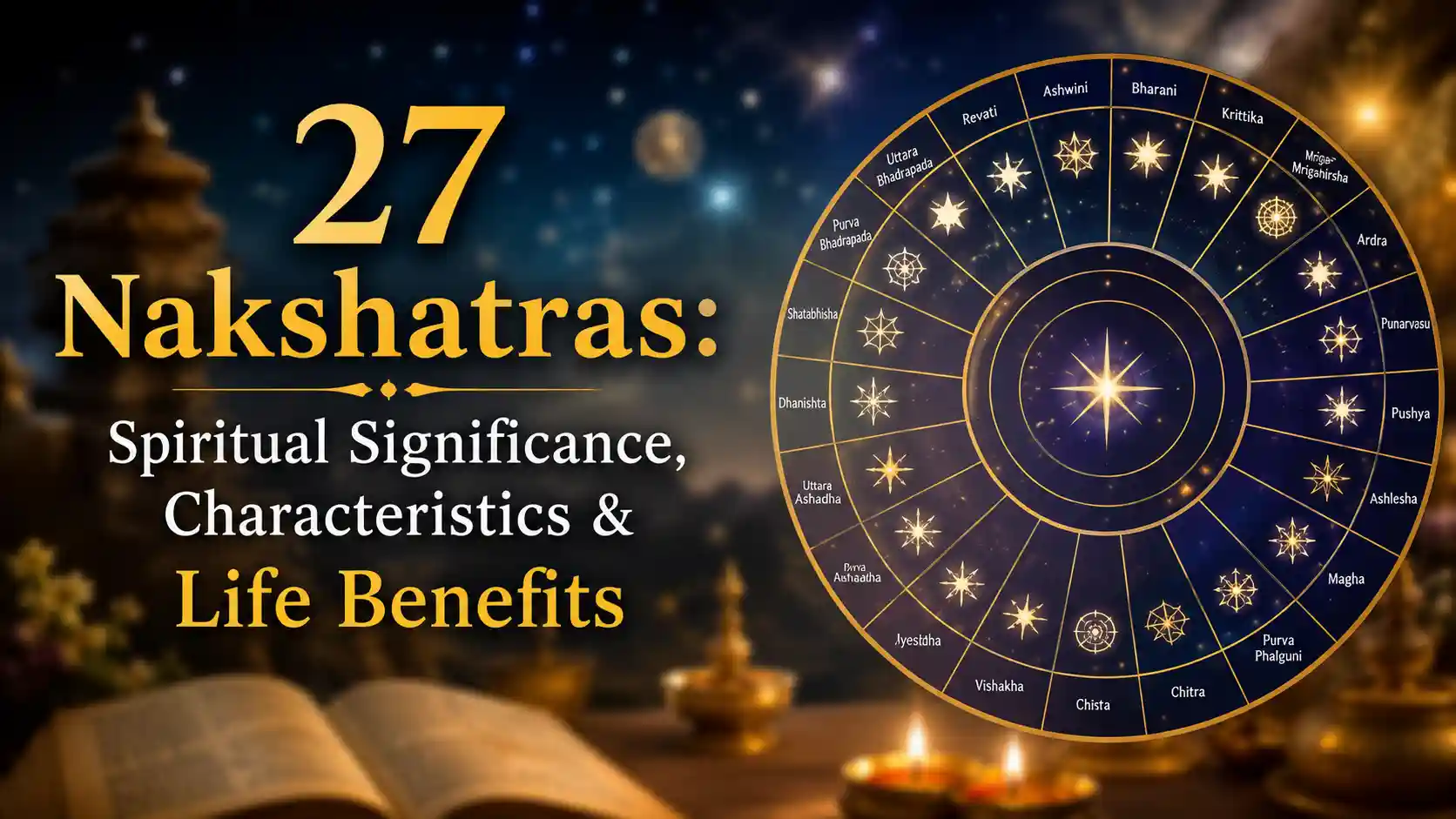
In this guide, we’ll explore the 27 Nakshatras, their spiritual significance, unique qualities, and why they continue to be one of the most fascinating aspects of Vedic astrology.
What Are Nakshatras?
The Sanskrit word Nakshatra means “that which never decays” or “star mansion.”
The celestial belt is divided into 27 equal sections, each covering 13°20′ of the zodiac. As the Moon completes its journey through all these divisions in about 27.3 days, each Nakshatra carries a distinct energy that influences human nature.
Rather than predicting fate, Nakshatras help us understand:
- Personality traits
- Emotional tendencies
- Natural talents
- Spiritual strengths
- Relationship compatibility
- Career inclinations
- Life lessons
- Karmic patterns
Think of the zodiac sign as the broad landscape and the Nakshatra as the detailed map that explains how a person expresses that sign.
Why Are the 27 Nakshatras Important?
For thousands of years, Vedic astrologers have used Nakshatras to understand life events with greater precision.
They are commonly used for:
- Birth chart interpretation
- Naming ceremonies
- Marriage compatibility
- Choosing auspicious dates (Muhurta)
- Spiritual practices
- Dasha (planetary period) calculations
- Understanding karmic tendencies
Because the Moon governs the mind and emotions, your birth Nakshatra often reveals how you think, feel, react, and connect with the world around you.
List of the 27 Nakshatras and Their Core Characteristics
| Nakshatra | Core Qualities |
|---|---|
| Ashwini | Healing, speed, new beginnings |
| Bharani | Courage, responsibility, transformation |
| Krittika | Leadership, determination, purification |
| Rohini | Beauty, creativity, prosperity |
| Mrigashira | Curiosity, exploration, learning |
| Ardra | Innovation, resilience, transformation |
| Punarvasu | Renewal, optimism, compassion |
| Pushya | Nourishment, wisdom, spirituality |
| Ashlesha | Intuition, psychology, mystery |
| Magha | Heritage, authority, leadership |
| Purva Phalguni | Creativity, love, enjoyment |
| Uttara Phalguni | Commitment, generosity, stability |
| Hasta | Skill, intelligence, craftsmanship |
| Chitra | Design, beauty, imagination |
| Swati | Freedom, independence, flexibility |
| Vishakha | Ambition, focus, achievement |
| Anuradha | Friendship, devotion, loyalty |
| Jyeshtha | Leadership, protection, responsibility |
| Mula | Truth-seeking, transformation, research |
| Purva Ashadha | Confidence, determination, victory |
| Uttara Ashadha | Success, ethics, perseverance |
| Shravana | Listening, knowledge, discipline |
| Dhanishta | Music, wealth, community |
| Shatabhisha | Healing, innovation, humanitarianism |
| Purva Bhadrapada | Spiritual awakening, philosophy |
| Uttara Bhadrapada | Wisdom, patience, inner peace |
| Revati | Compassion, prosperity, safe journeys |
Spiritual Significance of Nakshatras
Every Nakshatra is associated with:
- A ruling deity
- A planetary ruler
- A symbolic animal
- A sacred tree
- A unique spiritual vibration
These associations are used in traditional Vedic practices to understand one’s inner nature rather than to define destiny.
For example:
- Ashwini symbolizes healing and fresh beginnings.
- Rohini represents abundance, beauty, and creativity.
- Pushya is traditionally regarded as one of the most auspicious Nakshatras for learning and spiritual growth.
- Mula encourages self-discovery by helping individuals let go of outdated beliefs.
- Revati represents compassion, protection, and successful completion of life’s journeys.
Each Nakshatra teaches a unique life lesson, encouraging personal growth and self-awareness.
How Nakshatras Influence Your Life
Your Nakshatra is believed to influence several areas of life, including:
Personality
Your emotional style, communication patterns, strengths, and natural talents often reflect the qualities associated with your birth star.
Relationships
Nakshatra compatibility is traditionally considered during marriage matching because it focuses on emotional harmony and mutual understanding.
Career
Some Nakshatras naturally support leadership, creativity, teaching, research, healing, business, or artistic professions.
Spiritual Growth
Many spiritual traditions recommend meditation, mantra chanting, or devotional practices connected to one’s Nakshatra to cultivate mindfulness and self-reflection.
Decision Making
Nakshatra-based Muhurta (auspicious timing) is commonly used when selecting dates for weddings, business launches, housewarming ceremonies, and other significant events.
How to Find Your Birth Nakshatra
You’ll need:
- Date of birth
- Exact time of birth
- Birthplace
Using these details, the Moon’s position at birth determines your Janma Nakshatra.
Several reliable Vedic astrology software tools and qualified astrologers can calculate it accurately.
Common Misconceptions About Nakshatras
“My Nakshatra decides my destiny.”
Not entirely.
A Nakshatra highlights tendencies and potentials, but your complete birth chart—including planets, houses, ascendant, and planetary periods—must be considered for a meaningful interpretation.
“People born under the same Nakshatra are identical.”
No.
Two individuals sharing the same Nakshatra may express its qualities differently because of variations in their complete horoscope and life experiences.
Frequently Asked Questions
Are there exactly 27 Nakshatras?
Yes. Classical Vedic astrology recognizes 27 primary Nakshatras. Some traditions also discuss Abhijit as an additional lunar mansion for specific calculations.
Which Nakshatra is the most powerful?
There is no universally “best” Nakshatra. Each one has unique strengths, challenges, and spiritual purpose.
Can Nakshatras predict the future?
Nakshatras are traditionally used to understand tendencies and timing rather than to make absolute predictions.
Why is the Moon so important?
The Moon represents the mind, emotions, memory, and daily experiences. That’s why the Moon’s Nakshatra is central to Vedic astrology.
Final Thoughts
The 27 Nakshatras provide one of the richest frameworks in Vedic astrology for understanding personality, emotional patterns, and spiritual growth. Rather than viewing them as fixed predictors of destiny, they are best understood as symbolic guides that help individuals gain deeper self-awareness.
Whether you’re beginning your journey into Vedic astrology or exploring your own Janma Nakshatra, learning about the 27 Nakshatras can offer meaningful insights into your strengths, challenges, and life path.
Approach this wisdom with curiosity, reflection, and an open mind—it is a tool for understanding yourself, not a substitute for your own choices and actions.